She started with beads. Then things got a little out of hand.
The main author of Bead Culture, a collector of connections, professional follower of rabbit holes, and a woman incapable of asking one simple question without immediately needing eight books, four museums, two podcasts, and at least one completely unplanned side project.
She wanted to write about beads. Now she investigates half the world. And somehow, it makes perfect sense.

It all started quite innocently
Bead Culture was supposed to be about beads, jewelry, making things, and beautiful objects. But one problem appeared very quickly: a bead is never just a bead. It can be decoration, an amulet, currency, family memory, a marker of social status, part of wedding dress, a political symbol, a fashion statement, or an object that traveled halfway around the world long before its owner did.
And once Lola finds one of those threads, she wants to know where it leads. So beads gradually turned into trade routes, subcultures, fashion history, folk traditions, rituals, symbols, mythology, music, pop culture, aesthetic movements, festivals, everyday life, old photographs, museum storage rooms, and a great many things that were not on the plan that morning.
Bead Culture did not exactly grow according to a business plan. It spread. And Lola is running after it.
Lola does not know how to do a quick bit of research
This probably needs to be admitted immediately. Lola cannot open the internet, check one fact, and close it again. One question instantly requires eight books, two podcasts, four museum collections, three academic papers, an archive of old photographs, and the person who wrote a dissertation on the subject in 1987.
And then, of course, she discovers that the sources disagree. Excellent. Now it is finally getting interesting.
So a perfectly innocent question like “Why did flappers wear such long strings of pearls?” can, in a single afternoon, end up at the First World War, women’s emancipation, Art Deco, mass-produced costume jewelry, changes in the female silhouette, Prohibition, nightclubs, and the social transformations of the 1920s.
But once we are in the 1920s, it would obviously be absurd not to listen to period jazz. So Lola puts on jazz. By the third track, it occurs to her that Bead Culture obviously needs its own BC Jazz playlist. Which means finding out what should go on it. So: more research.
During that research she comes across a musician who deserves an article. Next to her name appears another topic. That topic connects to a Bead Culture article published half a year ago, so naturally it would be a shame not to update it and link everything together. Meanwhile, the notes acquire an idea for a new series and at least one completely unnecessary but irresistible rabbit tunnel.
The original question about a pearl necklace has now produced four new articles, a playlist, an update to an older piece, and an entirely new branch of Bead Culture that did not exist two hours ago.
Lola will, of course, return to the original article. As soon as she finishes the playlist. Maybe.
This is not a bug in the system. This is the system.
One world is not enough
That is why things can end up next to each other on Bead Culture that, at first glance, should never meet: a prehistoric bead, a Korean comeback, an African beadwork tradition, a flapper, a charm against the evil eye, a harvest festival, a punk jacket, a wedding jewel, or a strange object found in a digitized museum catalogue from 1912.
Lola is not particularly interested in the borders between categories. She is interested in what happens when we look at one thing from several sides. A piece of jewelry can simultaneously be a beautiful object, a craft, a historical document, a symbol of identity, a commodity, and a way a person tells others something about themselves. Fashion can lead to politics, music to clothing, religion to materials, and an ordinary bead to a story thousands of years old.
Sometimes it turns out that two seemingly distant things really are connected. Sometimes they are not connected at all. That is an answer too.
Not exoticism. Connections.
Bead Culture is not a collection of “curiosities from around the world,” and Lola does not want to turn cultures into display cases full of exotic oddities. When people somewhere wear something that seems unusual to us, the more interesting question than “look how strange this is” is: why?
Why do people around the world decorate their bodies? Why do some objects protect, others show social status, and still others tell a story about who someone belongs with? How does tradition become fashion, and fashion become subculture? How does a symbol move from one century to another and completely change meaning on the way? And why do things that look like brand-new internet aesthetics sometimes rest on stories much older than the internet itself?
Those shifts, transformations, and unexpected links are what fascinate Lola most. She does not want to simplify the world until it fits comfortably into five paragraphs. If something is complicated, it can stay complicated. If several interpretations exist, we can look at several interpretations. And if a beautiful legend is not a historical fact, there is no need to throw it away — it is simply fair to say that it is a legend.
The internet is not enough
Lola likes the internet very much. Obviously. She spends a suspicious amount of her life on it. But the first page of search results is not the end of research, and five websites repeating the same sentence are not five independent sources.
So Bead Culture keeps looking: in books, academic publications, archives, museum collections, university databases, historic newspapers, old photographs, documentaries, exhibition catalogues, recordings, maps, and wherever a particular topic leads. Sometimes the best source is new. Sometimes it has been waiting for a hundred years inside a digitized book almost nobody opens.
Bead Culture is not an academic journal, and Lola does not pretend to be someone who knows everything. Quite the opposite. One of the best parts of research is the moment she discovers that something she considered obvious is not obvious at all. Then it is time to dig deeper.
Research has side effects
One of Bead Culture’s problems is that information rarely stays just information. An article about a music subculture asks for a playlist, a historical era asks for a filmography, an interesting country asks for an entire series, a symbol asks for a map, an aesthetic asks for its own branch, and a tradition asks for a calendar. And while searching for one image, Lola discovers a museum whose collection deserves an article of its own.
That is how more articles, playlists, maps, timelines, databases, themed series, and ideas for things we cannot yet sensibly fit into the menu come into being. We have room for them. Somewhere.
So who is Lola Tralala, actually?
Lola Tralala is a pseudonym. And that is how it is supposed to stay.
Bead Culture is not meant to stand on the author’s face, her private life, or an endless stream of breakfast photos captioned with something about authenticity. Lola does not want to be an influencer. She would much rather point at something she found and say: “Wait. This is interesting.”
Anonymity lets her stand slightly to the side. The main character of Bead Culture is not Lola. It is the people, objects, cultures, subcultures, traditions, stories, and all the strange threads that connect them.
But “Tralala” is not an accident. Lola is not a walking encyclopedia, and Bead Culture is not supposed to sound like a textbook someone ordered you to finish by Monday. History can be serious and still be fun. An academic source can sit next to a stupid joke. And when a topic begins to look a little too dignified, there is a good chance Lola will poke it.
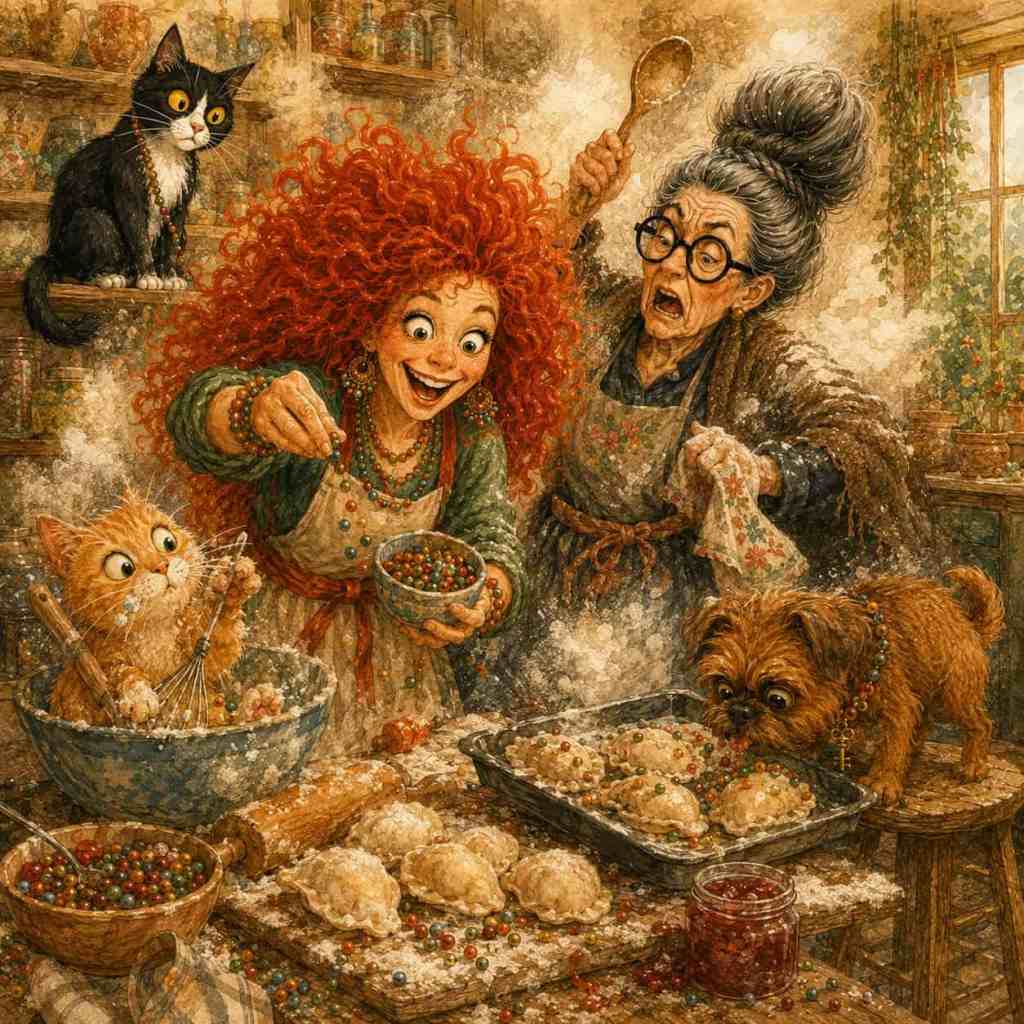
A little of the old Lola is still there
She has a weakness for old photographs, books, paper, textures, jewelry, colors, and things that have already lived a little. She can get excited about a hundred-year-old button, a forgotten necklace, a strange postcard, or a detail in a photograph that somebody else would not even notice. If she has to choose between a perfectly polished object with no story and a slightly battered one with a past, she is probably already holding the battered one.
So the poetry has not disappeared from Lola completely. She just no longer walks around with an upside-down umbrella trying to catch memories in it.
She has seventeen tabs open and is trying to find out where that umbrella came from, who made it, when people started using it, whether there is one in a museum collection, and why the handle has exactly that ornament.
And somewhere around tab twelve, she will probably think that we could actually do a whole series about umbrellas around the world.
That is more or less how Lola works. And more or less how Bead Culture is made.