
In Tel Aviv, Halloween can be planned as a small urban adventure: a pumpkin workshop, shadow theatre, a “cave of horrors”, a horror film and finally a party. A 2024 event guide offered activities for children and adults alike. Anyone determined to see it all mostly needed comfortable shoes—and perhaps a taxi. The vampires could stay home.
But this is a snapshot of one city and one Halloween programme, not a portrait of the whole country. In Tel Aviv, Halloween turns up in the schedules of clubs, cinemas and cultural centres. That does not make it a nationwide Israeli holiday, nor does it mean Halloween here is a ritual of remembrance for the dead.
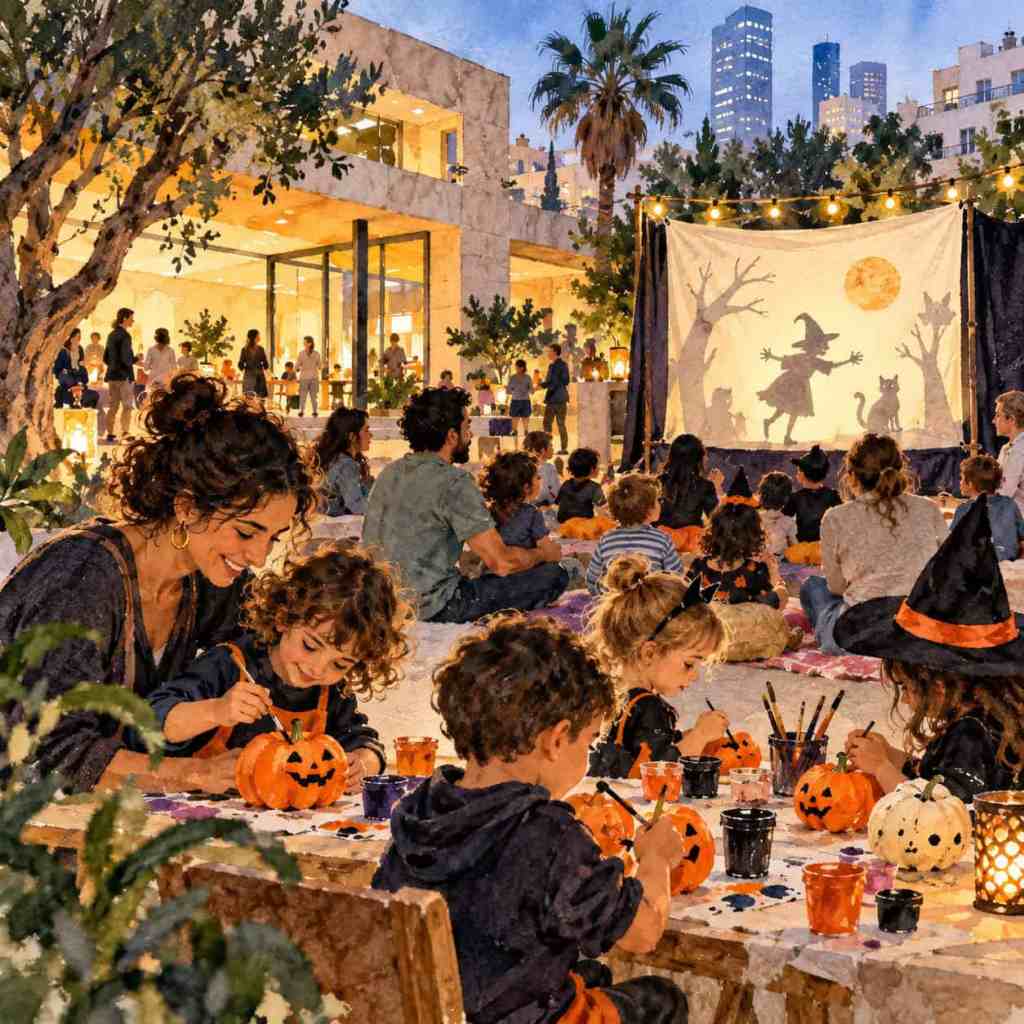
Costumes Have Another Date in Israel
If you meet children dressed as princesses or adults in elaborate costumes in Israel, it may not be late October at all. In spring comes Purim, a Jewish festival associated with the story of Queen Esther. Children and adults dress up, and parades take place in many cities. The National Library of Israel describes Purim as a joyful holiday in which costumes and processions have their place.
So the costume cupboard does not close for good in November. It merely rests until spring. Purim has its own story, date and meaning: it is not an Israeli version of Halloween, and it is not a day for commemorating the dead.

The Minute When Even Traffic Stops
Another evening, another sound. On the eve of Israel’s Memorial Day for Fallen Soldiers and Victims of Terrorism, known in Hebrew as Yom HaZikaron, a one-minute siren sounds at 8 p.m.
Drivers stop, step out of their cars and stand still. Work, conversations and dinners pause. For a moment, the noise of everyday city life becomes shared silence. Another siren sounds at 11 a.m. the following day, this time for two minutes. Memorial ceremonies take place across the country, including at cemeteries and schools.
Yom HaZikaron commemorates those who died in Israel’s wars and civilian victims of terrorist attacks. Its date follows the Jewish calendar, and it immediately precedes Independence Day. In the evening, the state memorial ceremony at Mount Herzl in Jerusalem ends and celebrations marking the founding of the state begin. The calendar makes a sharp cut: first silence, then a national holiday.
This is public, state-organised remembrance for particular groups of people, not a universal day commemorating everyone who has died. Israel also has a separate Holocaust Remembrance Day. In 2024, the government decided to establish another annual day of remembrance for the October 7 attack and the ensuing war. That memory remains immediate and painful; it does not belong among Halloween decorations.

One Family, One Candle, One Personal Date
Now shift the scale: from a siren heard across the country to a family remembering one person.
Yahrzeit is the anniversary of a person’s death according to the Jewish calendar. It does not align neatly with the civil calendar, and a Jewish day begins at sunset. The anniversary may therefore begin on the evening before the date someone using the ordinary civil calendar would expect.
One widespread custom is to light a memorial candle that burns for about 24 hours. Some mourners attend synagogue and recite Kaddish, a prayer praising God that is said in memory of the deceased. Others visit the grave or devote time to a good deed or study. Practices vary by family and community; there is no compulsory checklist for mourners to tick off.
Yahrzeit is not an Israeli public holiday. It is a Jewish family tradition found in communities outside Israel as well. And because Israel is religiously and culturally diverse, it cannot describe how all the country’s inhabitants remember their dead.

Even Mourning Has Its Old Jokes
The Jewish Museum in Prague preserves an online example of a joke printed back in 1935. Several men argue about who should have priority at the prayer lectern: one is observing a death anniversary, another the end of the first month of mourning, and a third has recently lost his father. Then a fourth arrives and declares: “I am a corpse myself—I have to pray!”
It is dark humour, but not mockery of the dead. The joke is aimed at the living and their endless disagreements about whose turn it is. Even a solemn tradition has human moments—and sometimes somebody trying to jump the queue.

Three Calendars That Do Not Merge
In Israel, Halloween entertainment in a city programme, a family death anniversary on the Jewish calendar and a state memorial day for fallen soldiers and victims of terrorism all exist side by side. At first glance, all touch on death or remembrance. Yet each answers a different question.
Halloween offers an evening of costumes, films and fun. Yahrzeit brings a family back to a particular person each year. Yom HaZikaron creates a shared silence for those commemorated by the Israeli state. And Purim? It opens the costume cupboard again in spring, but for an entirely different story.
Placed side by side, they do not form one Israeli “festival of the dead”. Instead, we see a map: a city party, a family candle and a siren that briefly brings the streets to a halt.
Frequently Asked Questions
What is Yom HaZikaron?
Israel’s state memorial day for fallen soldiers and civilian victims of terrorism. It follows the Jewish calendar and immediately precedes Israel’s Independence Day.
What does yahrzeit mean?
The anniversary of an individual’s death according to the Jewish calendar. Families may light a memorial candle, recite Kaddish or visit a grave; customs vary.
Why do sirens sound on Israel’s memorial day?
They signal a collective moment of silence. A one-minute siren sounds in the evening, and another lasts two minutes at 11 a.m. the next day.
Is Purim the same as Halloween?
No. Purim is a Jewish holiday connected to the Book of Esther. Halloween has a different history and appears in Israel mainly in modern costume and entertainment events.
Is Halloween a public holiday in Israel?
No. Some urban and international communities hold Halloween parties, but it is not a nationwide Israeli public holiday.
Does Israel have an equivalent to All Souls’ Day?
Not a direct equivalent. Yahrzeit is a personal death anniversary, while Yom HaZikaron honours particular groups in national remembrance.
How do yahrzeit and Yom HaZikaron differ?
Yahrzeit focuses on one person and their family; Yom HaZikaron is a national memorial day for fallen soldiers and civilian victims of terrorism.
🧵 Where the Threads Lead
- Secret Tel Aviv: 2024 Halloween events
- National Library of Israel: Yom HaZikaron
- National Library of Israel: Purim
- Israel Defense Forces: how Yom HaZikaron is observed
- Chabad.org: understanding yahrzeit
- Jewish Museum in Prague: an archival joke about mourning
- Israeli government: annual remembrance of October 7
- RTVE: Spanish-language programme on Yom HaZikaron
📚 Go a Little Deeper
To explore the subject further, start with the National Library of Israel and its explanation of the national memorial day. For family customs around death anniversaries, read Chabad.org. The important distinction is between state mourning, religious practice and a family’s personal memory.

Halloween, All Souls’ Day and Festivals of the Dead Around the World: A Big Guide to Traditions That Are Not the Same
Halloween, All Souls’ Day, Día de Muertos, Undas, Fèt Gede and giant Guatemalan kites: a guide to what happens around the world at the end of October and beginning of November — and why these traditions do not merge into one.
Keep reading