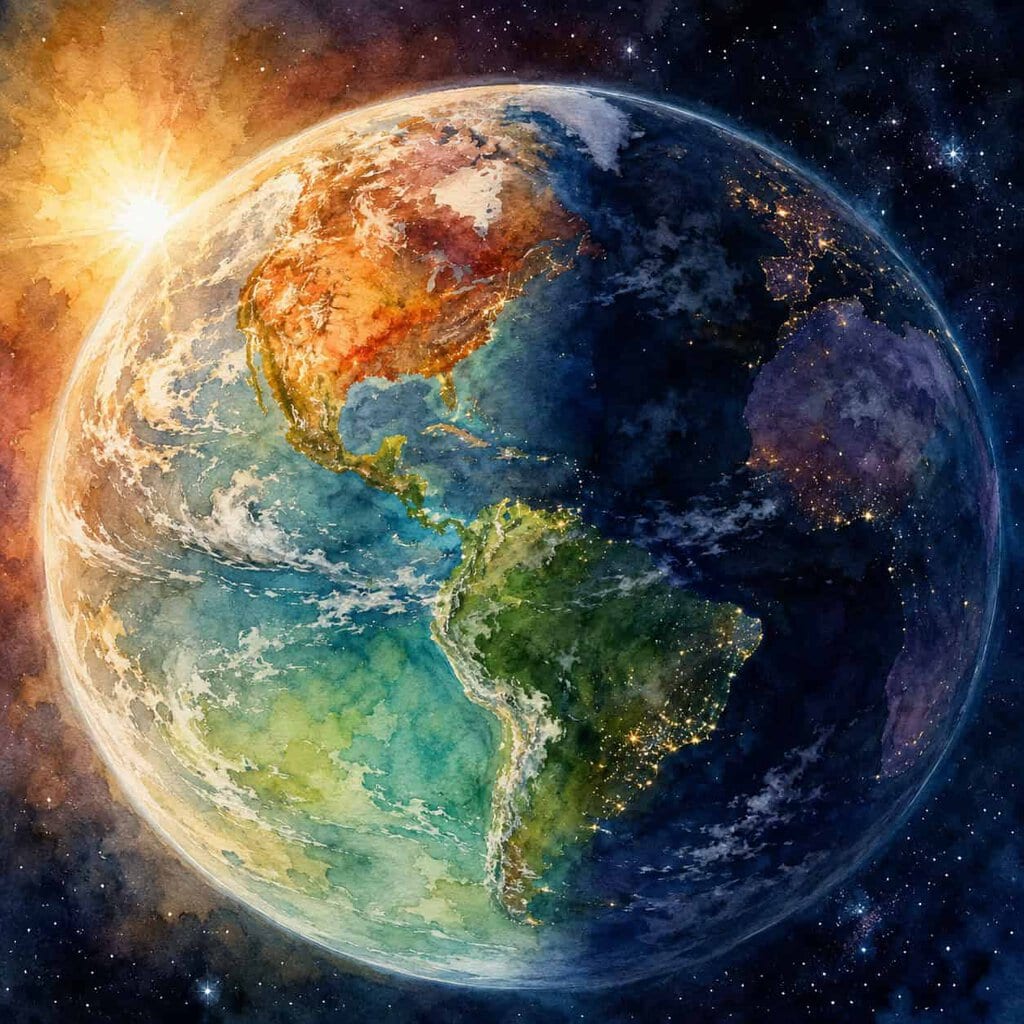
Sometime around the end of September, the internet starts behaving as if the planet has been issued a single dress code. Leaves. Pumpkins. Cinnamon. Candles. A burgundy sweater. A gold pendant with the Sun and Moon. Add a few lines about the “perfect balance of light and darkness,” and according to the algorithm we are apparently all ready to enter autumn.
Except Earth has one small design flaw: it is round, tilted, and inhabited by billions of people who have never divided the year in exactly the same way.
At the moment astronomical autumn begins in Prague, astronomical spring opens in the Southern Hemisphere. In parts of Australia, meanwhile, local seasonal calendars do not need the European idea of “spring” at all. In Japan, the equinox meets traditions of remembering ancestors. In China, the autumn equinox is one of the traditional solar terms. And since 2018, the day of the autumn equinox has also been the date of the Chinese Farmers’ Harvest Festival — a modern nationwide celebration of harvest, agriculture, and the people who keep it alive. Alongside all that, dozens of other festivals take place in September and October that sit close to the equinox on the calendar without actually being equinox festivals.
So yes: today we are following the equinox around the planet. But first we need to take the pumpkin out of its hand and work out what it actually is.

The equinox is not a day. It is a moment
Let’s begin with a small astronomical ambush. An equinox does not last twenty-four hours.
It is the precise moment when the center of the Sun, in its apparent movement across the sky, crosses the plane of Earth’s equator. In 2026, the September equinox 2026 occurs on 23 September at 00:05 UTC. It happens at the same instant for the entire planet — only local clocks and calendars may show a different time, or in some places even the previous date.
The seasons do not change because Earth dramatically wanders farther from the Sun in winter and then cuddles up to it in summer like a cat to a radiator. The main reason is Earth’s axial tilt of roughly 23.5 degrees. As Earth travels around the Sun, the angle of incoming sunlight and the length of the day change across the hemispheres.
At the equinox, neither the Northern nor the Southern Hemisphere is tilted toward the Sun more than the other. Solar energy is distributed between them roughly symmetrically, and the boundary between day and night, seen from space, runs almost from pole to pole. It is beautiful geometry.
And now we are going to spoil it slightly.
Day and night are equal. Well… almost
The word equinox comes from the Latin aequus, meaning equal, and nox, meaning night. So it is entirely reasonable to expect twelve hours of daylight, twelve hours of darkness, and a cosmic set of accounts balanced to the last cent.
The atmosphere, however, is not an accountant.
Sunlight bends as it passes through the atmosphere, so we can still see the Sun above the horizon when geometrically it is already slightly below it. And when sunrise and sunset are measured, we use the visible edge of the Sun rather than its geometric center. As a result, the actual time from sunrise to sunset is usually a little longer than twelve hours on the equinox.
The day on which daylight and darkness come closest to a true twelve-to-twelve split may occur several days before or after the astronomical equinox, depending on latitude. The term equilux is sometimes used for it.
So the sentence “day and night are exactly the same length everywhere on the equinox” belongs to that charming category of claims that are almost true — which is exactly why they spread so beautifully.
An equinox is not the moment when someone upstairs cuts a twenty-four-hour cake precisely in half. It is a geometric event in the movement of Earth and the Sun.

Autumn in the north, spring in the south. And we are still not finished
For us in Central Europe, the September equinox marks the beginning of astronomical autumn. The days continue to shorten, the Sun stays lower in the sky, and we head toward the December solstice.
In the Southern Hemisphere, the opposite is happening. The September equinox marks the astronomical beginning of spring, and daylight continues to increase.
If we ended the article here, it would be neat, tidy, and even true.
Just not complete.
The familiar four-part division — spring, summer, autumn, winter — comes from regions where that pattern fits the climate reasonably well. It is not the planet’s universal cultural operating system.
Australia’s Bureau of Meteorology itself points out that the familiar division into spring, summer, autumn, and winter follows a European model. Australian landscapes, however, never signed a contract promising to behave like Europe. In the tropical north, a division between wet and dry seasons often makes far more sense. And different Aboriginal and Torres Strait Islander communities use calendars with three, five, six, or other locally defined seasons based on weather, flowering plants, animal behavior, winds, rainfall, and other environmental signs.
The Nyoongar people of southwestern Australia, for example, work with six seasons. Their beginnings are not dictated by a red line on a calendar but by what is actually happening in Country, so individual seasons may be longer or shorter.
And this is where an innocent calendar becomes a question of cultural history. The National Library of Australia notes that the idea of four distinct seasons was brought to the continent by colonists. Academic research has also explored how the European seasonal calendar became institutionalized in Australia even though local environments and Indigenous knowledge systems often describe the year more accurately in other ways.
This is not a ban on the word spring. It is something more interesting: a reminder that a calendar is not nature itself. It is one of the ways humans have chosen to read nature.
🧐 Orla Křen reports: “The equinox is not a global dress code. The planet really does not change into ochre just because Pinterest opened September.”

Where the equinox really is part of the tradition
This is where the internet starts loving shortcuts. We have September, harvest, the Sun, ancestors, a full Moon, apples, and several different calendars — and within five minutes they have been blended into one supposedly ancient “equinox festival.”
But some traditions really are tied to the equinox very directly.
In Japan, the autumn equinox is a national holiday called Shūbun no Hi. In 2026 it falls on 23 September, and its officially stated purpose is to honor ancestors and remember those who have died.
Around both the spring and autumn equinoxes there is also higan, a seven-day period consisting of the three days before the equinox, the equinox itself, and the three days after it. Autumn higan is associated with customs such as visiting family graves and eating sweet ohagi made from rice and red beans.
Here the equinox is not seasonal decoration. It is built directly into the calendar structure of the custom.
In China, Qiūfēn, the autumn equinox, is one of the traditional twenty-four solar terms. And since 2018, the Chinese government has designated the day of the autumn equinox as the annual Chinese Farmers’ Harvest Festival, a nationwide celebration focused on agriculture and harvest.
This is also a perfect example of why it is risky to throw every tradition into a box labeled “ancient.” The solar term has a long history; the national Farmers’ Harvest Festival is a modern institution dating to 2018. Both can exist side by side without secretly gluing a three-thousand-year-old beard onto the newer one.

And what about all those harvest festivals nearby?
This is where we need cultural tweezers.
Being close on the calendar does not make two festivals the same thing. A festival may celebrate harvest, ancestors, the Moon, or a seasonal change and still not be an equinox festival.
China’s Mid-Autumn Festival, for example, falls on the fifteenth day of the eighth month of the lunar calendar. It is strongly associated with the full Moon, family reunions, and mooncakes — not with the fixed astronomical moment of the September equinox. Its Gregorian date therefore shifts from year to year.
The same distinction matters for Korea’s Chuseok, which falls on the fifteenth day of the eighth lunar month. It also carries strong family, ancestral, and harvest traditions, but it is not defined by the date of the astronomical equinox.
And this is exactly where our series is going to have plenty of work to do. September and early October in the Northern Hemisphere are so crowded with harvest, lunar, religious, and family festivals that the internet sometimes throws them all into one giant Autumn Spiritual Smoothie™.
We would rather take them apart again.
Not because we want to ruin anyone’s magic. Quite the opposite. Every one of these traditions becomes more interesting when we allow it to be what it actually is.

And then came Mabon
Search for autumn equinox and it will not take long before Mabon appears. Usually accompanied by apples, candles, grain, orange leaves, and a sentence suggesting that the Celts celebrated the equinox this way back when stones could still talk.
This is where we need the handbrake. The internet has a peculiar talent for taking a tradition born in the twentieth century, putting antlers on it, handing it an apple, and sending it two thousand years into the past.
Contemporary Pagan and Wiccan celebrations of the autumn equinox are real modern religious traditions. Being modern does not make them less meaningful to the people who practice them today. Historically, however, it is not accurate to present today’s Mabon automatically as an uninterrupted ancient Celtic festival of the autumn equinox.
Historian Ronald Hutton, writing about modern Pagan festivals, describes how the American Pagan Aidan Kelly used the name Mabon for the autumn equinox while shaping a modern Pagan festival calendar, and how the term spread through American modern Paganism during the 1970s and later into Britain. Mabon himself is a figure from medieval Welsh literary tradition; the connection between his name and the autumn equinox is a modern construction.
And that is one of the themes we will meet again and again in this series: a new tradition does not have to pretend to be ancient in order to matter.
The internet, of course, loves antiquity. “A ritual created in the twentieth century” apparently does not sound as algorithmically sexy as “a forgotten secret of the Celts.” History occasionally has a truly terrible marketing department.

Where are the jewelry, talismans, and all the beautiful things?
Of course they are here. This is BeadCulture. If we traveled around the entire planet without noticing what people wear, place on tables, give to the dead, hang in their homes, or keep in their pockets, somewhere in the editorial office a bead would start rattling by itself.
But the equinox is an excellent lesson in being careful.
There is no single universal “autumn equinox jewelry tradition.” There is no planetary set of sacred stones, colors, and plants that means the same thing from Japan to Czechia to Australia.
Within specific traditions, we may find flowers, foods, offerings, and objects connected with ancestors, harvest, or a local season. Japanese autumn higan, for example, has its ohagi. Chinese harvest celebrations may include local crops, regional crafts, and agricultural symbols. In Indigenous Australian seasonal systems, specific plants, animals, winds, or rains may signal changes in Country.
And then there is the contemporary visual language of the equinox. Sun and Moon. Two halves of a circle. Light and dark metal. Seeds. Grain. An apple. A dry leaf. A green shoot for the Southern Hemisphere. Pairs of colors or materials that capture transition.
All of that can be used in jewelry design.
We simply do not need to invent a fake family tree for it.
A necklace with a brass Sun and a black stone can be a beautiful modern piece of equinox-inspired jewelry. We do not need to claim that “the ancient Celts wore black onyx for balance during Mabon” unless we actually have evidence for it. The bead will survive. History will sit down in relief.

So what does September mean in different parts of the world?
In Czechia and much of the temperate Northern Hemisphere, we are moving into astronomical autumn. Vegetation changes, harvest season continues, and the days keep getting shorter. Within several days after the equinox, night truly becomes longer than daylight — because even here the atmosphere refuses to cooperate with our lovely picture of a perfectly halved day.
In Japan, the astronomical transition meets a national holiday and higan, giving the equinox a strong layer of remembrance for the dead.
In China, it is Qiūfēn within the system of twenty-four solar terms and also the date of the modern Farmers’ Harvest Festival. A few days or weeks away, depending on the lunar calendar, the Mid-Autumn Festival may appear — close in season but governed by a different calendar. Even here, calendars and astronomy do not always hold hands perfectly. The fifteenth day of a lunar month is associated with the full Moon, but it does not have to coincide exactly with the astronomical instant of the full Moon. In 2026, for example, the festival falls on 25 September while the full Moon itself occurs two days later. Calendars are not astronomical stopwatches.
In southwestern Australia, September can be read through a completely different map. In the Nyoongar calendar it falls roughly within Djilba, whose boundaries are flexible and follow real environmental changes. European “astronomical spring” therefore exists as one system of description, not as the only correct translation of the local year.
In northern Australia, the word spring may be even less useful. Tropical regions often orient themselves around wet and dry parts of the year, while Indigenous calendars have their own local seasonal divisions.
In Aotearoa / New Zealand, there are different forms of maramataka — Māori systems of timekeeping that follow the Moon, Sun, stars, and what is happening in the environment. Because different iwi have their own traditions and knowledge, maramataka is not one universal calendar someone could print on the whole country’s refrigerator.
One astronomical event.
Six places.
And already six different stories.
The equinox is shared. Its meaning is not
Perhaps that is the most beautiful thing about the equinox.
Astronomy is uncompromising here. Earth moves, its axis is tilted, and the Sun does not read cultural calendars. The September equinox happens for the entire planet at one instant.
But the moment sunlight reaches the ground, the human world begins.
In one place, people remember ancestors. In another, they celebrate harvest. Somewhere, people begin talking about spring. Elsewhere, a particular plant is flowering, a certain wind is blowing, or rain arrives — and those signs tell a local calendar more about the season than the date 23 September ever could.
And somewhere, a person lights a candle, picks up a modern Sun-and-Moon talisman, and creates a personal ritual. That too is part of contemporary culture — as long as we know it is contemporary.
That is why this series will not search for one “true celebration of the autumn equinox.”
It is going to do something much more fun.
We are going to follow one moment in the sky and hundreds of ways people read it down here on Earth.
And every now and then, one of those supposedly ancient internet traditions is going to have its ID checked.

🧵 Where the threads lead
This article grew from a mix of astronomical data, official calendars, museum materials, and research into cultural traditions. These are some of the main threads we followed:
U.S. astronomical season data
For the timing of the September equinox in 2026. Yes, the universe really does keep better attendance records than most people on a Monday morning.
NASA and NOAA
For the astronomy of equinoxes, Earth’s axial tilt, the seasons, and the small problem with the beautiful idea that day and night must obediently last exactly twelve hours.
Cabinet Office, Government of Japan, and the National Diet Library of Japan
For the national holiday Shūbun no Hi, the period of higan, and their actual place in the Japanese calendar — no need to manufacture a universal “autumn spirituality” around them.
Government of Japan
For the official calendar context around the autumn equinox holiday.
State Council of the People’s Republic of China and official Chinese government information
For Qiūfēn as one of the twenty-four solar terms and for the creation of the modern Chinese Farmers’ Harvest Festival in 2018.
Australian Bureau of Meteorology
For the European origins of the familiar Australian four-season model, tropical wet/dry seasonal divisions, and Indigenous seasonal calendars. This thread also leads to the six Nyoongar seasons and the pleasant realization that Country sometimes knows more about the season than a wall calendar does.
Museum of New Zealand Te Papa Tongarewa
For maramataka, Māori ways of tracking time through the Moon, Sun, stars, and environmental signs — and for the important reminder that there is no single universal calendar shared identically by all iwi.
Ronald Hutton
For research on modern Pagan festivals that helps untangle the story of the name Mabon, Aidan Kelly, and the modern association between that name and the autumn equinox. Because a tradition can be beautiful without a fake birth certificate from the Stone Age.
📚 Want to go deeper?
If the equinox has just pulled you into a small calendrical rabbit hole, these are good places to keep digging:
Australian Bureau of Meteorology – Indigenous Seasonal Calendars
An excellent introduction to different Indigenous Australian seasonal systems. Instead of four colored boxes for the year, you get rainfall, wind, flowering plants, animal behavior, and very specific landscapes.
Museum of New Zealand Te Papa Tongarewa – maramataka and Matariki
For a deeper look at Māori calendrical knowledge, relationships between sky and environment, and differences among traditions.
National Diet Library of Japan – traditional Japanese calendar
If higan, the equinoxes, and the meeting point between astronomical markers, holidays, and older calendrical layers caught your attention, this is an excellent place to begin.
And if you are mainly interested in what people wear, make, offer, hang on the body, or hide in a pocket around seasonal transitions, stay close. That is where this series is only just beginning to sparkle properly.
When is the September equinox in 2026?
The September equinox occurs on 23 September 2026 at 00:05 UTC. It is one precise astronomical instant shared by the entire planet, even though local clocks — and in some places even the date — may show something different.
Are day and night exactly the same length at the equinox?
Not quite. Because of atmospheric refraction and the way sunrise and sunset are defined, the time between sunrise and sunset is usually a little longer than twelve hours at the equinox. The day when daylight and darkness come closest to a 12:12 balance may fall several days before or after the equinox and also depends on latitude.
Does autumn begin everywhere on Earth at the September equinox?
No. Astronomical autumn begins in the Northern Hemisphere, while astronomical spring begins in the Southern Hemisphere. Even that division is not a universal cultural map of the year. In tropical regions and Indigenous seasonal systems, rainfall, dryness, winds, flowering plants, animal behavior, and other local environmental signs may matter more.
Is Mabon an ancient Celtic festival of the autumn equinox?
Not in the form often claimed online. Mabon is a real modern Pagan and Wiccan name for the autumn equinox, but it is not a documented, uninterrupted ancient Celtic festival name. Historian Ronald Hutton connects its modern use with Aidan Kelly and the formation of a modern Pagan festival calendar in the twentieth century.
How is the autumn equinox connected with Japan?
In Japan, the day of the autumn equinox is a national holiday called Shūbun no Hi. Around the equinox there is also higan, a seven-day period covering the three days before the equinox, the equinox itself, and the three days after it. The period is associated with traditions of remembering ancestors and visiting family graves.
Is the Chinese Farmers’ Harvest Festival an ancient Chinese festival?
No. Qiūfēn, the autumn equinox, has a long history as one of the traditional twenty-four Chinese solar terms. The Chinese Farmers’ Harvest Festival, however, is a modern nationwide festival established by the Chinese government in 2018 and scheduled for the day of Qiūfēn.
Is the Mid-Autumn Festival an autumn equinox festival?
No. The Mid-Autumn Festival follows the lunar calendar and falls on the fifteenth day of the eighth lunar month. It is associated with the Moon, family, and the harvest season, but its date is not determined by the astronomical equinox. Calendar proximity does not make two traditions identical.
Are there traditional equinox stones, colors, or jewelry shared by all cultures?
No. There is no universal set of “equinox stones,” colors, or talismans shared by the whole planet. Specific cultures may have their own objects, foods, plants, offerings, clothing, or symbols connected with a season or festival. The Sun, Moon, grain, leaves, or the contrast between light and darkness can absolutely inspire contemporary equinox jewelry — but modern inspiration does not need a fake ancient pedigree.

Halloween and Remembrance of the Dead in Georgia: Two Different Traditions
Halloween in Tbilisi is a contemporary urban event. Georgian kelekhi belongs to funeral and memorial practice — it is neither Halloween nor one nationwide All Souls’ Day.
Keep reading

Why Do the Dead Return at the Turn of October and November? Halloween, Saints, Souls and One Very Tangled History
How did Samhain, All Saints, prayers for the dead, Irish turnips, guising and American pranks become Halloween with pumpkins, costumes and bags of candy?
Keep reading 
Halloween, All Souls’ Day and Festivals of the Dead Around the World: A Big Guide to Traditions That Are Not the Same
Halloween, All Souls’ Day, Día de Muertos, Undas, Fèt Gede and giant Guatemalan kites: a guide to what happens around the world at the end of October and beginning of November — and why these traditions do not merge into one.
Keep reading Something went wrong. Please refresh the page and/or try again.