
BTS are not a story you can explain in one sentence. And anyone who claims otherwise has either never fallen down the fandom rabbit hole, or still thinks “Dynamite” is just a cheerful disco song and that the case is closed. Which is adorable. Also untrue. A bit like saying the ocean is just a bigger puddle and a shark is merely an anxious carp with a PR department.
BTS are a long journey through pressure, talent, sweat, humor, music, chaos, fandom obsession, and seven people who went from trainee boys in a small agency to one of the most influential music groups in modern pop culture. Not because they had one good hit. Not because they knew how to stand in the wind like an expensive shampoo commercial. But because their career began to work like a coming-of-age arc: from school rebellion to the pain of youth, questions of identity, self-love, the shadow of fame, pandemic exhaustion, solo searching, and finally the return to the group.
This is a big map. Not an encyclopedic binder that beats you unconscious with dates until you forget your own tax number, but a guide to how BTS changed. Musically, visually, thematically, and humanly. Because with BTS, it is not enough to know what they released. What matters is understanding why it came at that exact moment, what it opened, and why so many people looked like they were simply watching a music video while in reality they were signing an invisible contract with fandom destiny.
Lola comments: “BTS are not a timeline. BTS are an emotional highway with rest stops selling merch, tears, existential questions, and every now and then a completely unnecessary photocard so beautiful it makes you rethink your budget.”
How to read this map
There are several ways to follow BTS. You can go by albums, by era, by style, or by hair color, which is not an academic method, but the fandom uses it with dangerous precision. Or you can follow the way the central theme in their music keeps changing: who am I, what does the world want from me, what do I want, why does success sometimes hurt, what does it mean to love myself, and can a group survive the moment when every member needs to become himself?
This article moves chronologically. It begins with the trainee period, then goes through the debut, the school trilogy, HYYH, Wings, Love Yourself, Map of the Soul, the pandemic, BE, Proof, the solo era, and the return after the military hiatus. Each section is one piece of a larger puzzle. Together, they show why BTS did not rewrite pop culture in one explosion, but through a long series of steps that first seemed small.
And then they stopped being small. Then they became a cultural combine harvester that drove through the internet, charts, fashion, fan theories, and the lives of people who originally only wanted to know which one had the deep voice.
Babča comments: “Exactly. A person only wants to learn their names, and three days later she knows who changed hair color when, but still cannot find her own receipts.”
Before the debut: when nobody knew what was being born yet
Before BTS, there was no obvious global plan. It was not a situation like: let’s put together seven boys, add a little hip-hop, social media, three drops of tears, two drops of hair gel, and in a few years we will conquer the world. Pop culture does not work like that, even if marketing presentations sometimes pretend it does. At the beginning, there was Big Hit Entertainment, a small agency, the trainee system, rap energy, and a group of young people learning to survive in an environment where talent is not enough.
The original core was strongly connected to hip-hop. RM came with a rap background, SUGA with production and underground experience, j-hope with a dance foundation and later rap. Other members gradually joined them, bringing different colors into the group: Jin’s voice and stability, Jimin’s dance intensity, Taehyung’s deep tone and aesthetic alienness, Jungkook’s versatility and hunger to grow so fast that the fandom probably developed collective dizziness.
And this is the first key: from the beginning, BTS were not simply a beautifully arranged group with one shared type of energy. They were a mixture. Part rap collective, part idol group, part overworked teenagers, part experiment that could have fallen apart if it had not been held together by work, chemistry, and brutal persistence. On paper, it may have looked risky. In practice, it became an explosive mixture no sensible person would store next to an open flame.
Orla Křen comments: “Every great ritual begins in chaos. Only today, instead of fire and drums, we have a practice room, a microphone, and someone yelling: one more time, this time without dying in your eyes.”

2013–2014: the school trilogy and a debut without a pink bow
BTS debuted in 2013 with the single album 2 Cool 4 Skool and the track “No More Dream.” And that matters, because their beginning was not sweet, polished, or safely cute. They did not step onto the scene like porcelain dolls with smiles on their faces and an empty “please buy the album” look in their eyes. They arrived with a question: what is your dream — and is it really yours?
The school trilogy, which includes 2 Cool 4 Skool, O!RUL8,2?, and Skool Luv Affair, dealt with school pressure, adult expectations, dreams, rebellion, first love, and finding one’s own path. It was louder, sharper, sometimes even awkward in the most human sense. BTS were not global icons yet. They were a young group trying to speak the language of a generation that kept hearing the same commands over and over: study, be quiet, succeed, fit in, do not talk back, smile, and please do not complicate anyone’s spreadsheets.
This beginning is easy to skip today, because later BTS are more elegant, more mature, and far more precise. But without the school trilogy, the rest does not make sense. This is where the basic BTS DNA appears: music as a space for social pressure, personal voice, resistance, and the feeling that a person does not want to function according to someone else’s manual. And yes, some of the styling from this era looks like a hip-hop school trip through a chain store, but the energy was there from the start.
Lola comments: “Early BTS are like the first pancake. Not always perfectly round, occasionally a bit dramatic, but without it there would be no breakfast.”

2014: Dark & Wild and the search for direction
In 2014 came Dark & Wild, BTS’ first studio album. The title alone says a lot. Here, the group begins to expand beyond the purely school-based frame into a larger space of emotions, relationships, frustration, and their own sound. The hip-hop foundation is still there, the youthful energy is still there, but a bigger ambition begins to appear: not just to be a group with a message, but a group with musical range.
Dark & Wild is a little like a room where nobody has had time to tidy up the cables yet, but the amplifier is already plugged in. It is not polished. Sometimes it is dramatic. Sometimes it is hard. Sometimes it fights with what it wants to become. And that is what makes it interesting. BTS at this time are not presenting themselves as a finished phenomenon. They are growing in front of your eyes. Searching for shape, testing their force, sometimes pushing too hard, sometimes wobbling, but always carrying hunger.
For a fan who comes to this era later, it can be fascinating mainly because it shows the group before the big turning point. Before HYYH. Before the global explosive growth. Before their story began to be read as one of the major pop-cultural arcs of the 21st century. Here they are still in the phase of: we know we want more, but we do not yet know exactly what that more will sound like. And that is always the most alive thing about beginnings, because the future has not put on its make-up yet.
Roxy Riot comments: “This era has muddy boots, hands full of cables, and a beat in its pocket that still does not know how to greet politely. Good.”
2015–2016: HYYH and the pain of beautiful youth
Then came HYYH. The Most Beautiful Moment in Life. In Korean, 화양연화, often translated as the most beautiful moment of life. And here BTS began to change from a promising group into something much larger. Not yet a global machine. But already a story that slipped under people’s skin so quietly they only noticed when they found themselves sitting over a music video, reading a thirty-paragraph theory, and thinking: how did I get here?
The HYYH era, meaning The Most Beautiful Moment in Life Pt. 1, Pt. 2, and later Young Forever, moved BTS from school rebellion into a deeper emotional landscape of youth. It was no longer only about pressure from the system. It was about that strange age when you are running forward but have no idea where. When everything is intense, fragile, beautiful, and at the same time a little destructive. Friendship, escape, loneliness, fear, dreams, falls, and the moments when you laugh too loudly because otherwise you would have to cry into your sleeve and pretend it is a style choice.
This is also where BTS’ visual and narrative language develops strongly. The music videos are not just pretty accompaniments to the songs. They begin to feel like fragments of a larger story, like memories scattered across a table waiting for someone to put them together. The fandom, naturally, began putting them together. With enthusiasm, theories, tears, and the energy of a detective department that uses comeback trailers instead of coffee.
HYYH is one of the most important BTS eras because this is where they form their ability to connect music, image, emotion, and identification. You did not have to understand every symbol to feel it. You only had to know the feeling: youth as a beautiful thing that hurts because it cannot be held.
Klóda Violeta comments: “HYYH is the aesthetic of a person running toward the sunset and not knowing whether they are running away from pain or toward it. So yes, ideal playlist material at two in the morning.”

2016–2017: Wings and the temptation of adulthood
After HYYH came Wings. And with it, BTS entered a darker, more symbolic, more adult phase. If HYYH was youth running along the edge of an abyss, Wings is the moment when a person looks down and says: ah, so that is my shadow side. Excellent. Did anyone bring a flashlight, a therapist, and something sweet?
Wings works with motifs of temptation, guilt, growth, pain, desire, and the loss of innocence. It is often connected with literary references, especially Hermann Hesse’s novel Demian. Here BTS showed that a pop group could use symbolism, literary inspiration, and personal themes without ceasing to be musically accessible. In other words: yes, you can have a catchy chorus and an existential crisis wrapped in velvet at the same time.
The structure of the album was also very important, because individual members were given stronger space through solo songs. That was not just fan delight in the style of “everyone gets a moment, quick, prepare the tissues.” It was preparation for something that would later prove essential: BTS are not an anonymous whole. They are seven personalities, seven voices, seven types of sensitivity that work together precisely because they are not the same.
For many fans, Wings is the era when BTS stopped being “a group I enjoy” and became “a group that took me apart, thank you, where do I send the therapy invoice?” It is also the era when the fandom fully understood that this was not going to be only about dancing. This was going to involve reading, analyzing, suffering, and voluntarily coming back for another dose.
Madam Chaotika comments: “The tarot showed temptation, shadow, and dramatic hairspray. The tea is silent, which means this will be important.”

You Never Walk Alone: the bridge between pain and comfort
The repackage You Never Walk Alone closed the Wings phase and brought one of BTS’ most essential songs ever: “Spring Day.” If HYYH hurt with youth and Wings hurt with temptation, “Spring Day” hurts with loss, waiting, and hope that is neither quick nor simple.
“Spring Day” is not a song that tells you “everything will be fine” and pats your shoulder like a motivational calendar from a stationery shop. It is a song that sits down beside you in the cold and says: I miss someone too. I am waiting too. I do not know when spring will come either. And that is exactly why it has survived so powerfully in the collective memory of fans.
This period shows another important thing: BTS can be big without losing intimacy. They can have choreography, stadiums, concepts, and massive production, but their strongest moments often stand on a simple human feeling. I miss you. I am afraid. I keep going. I will wait. And maybe one day we will meet in spring, even if that spring arrives later than both the weather forecast and mental stability promised.
Babča comments: “When someone turns waiting into a song that hugs you and steals your tissue at the same time, that is not pop. That is emotional mail.”
2017–2018: Love Yourself and the global turning point
Then came the Love Yourself series: Her, Tear, and Answer. And this is where BTS entered the phase that definitively launched them onto the global scale. “DNA,” “Fake Love,” “IDOL,” the entire idea of self-love, the UNICEF LOVE MYSELF campaign, their appearance and speech at the UN. Suddenly BTS were not just a major K-pop group. They became a cultural symbol, and that is exactly the moment when pop culture starts acting like it expected this all along. It did not. It was just pretending it had everything under control.
Love Yourself is interesting because it does not stop at the simple mantra “love yourself.” That would be cheap, and BTS usually do not tolerate cheap emotions for very long. This series shows love as a process. First fascination and attraction, then pain and false image, and finally a return to the self. “Fake Love” is key here: what happens when you try to become someone else so that someone will love you? And how much of you is actually left when you take off the mask, the stick-on smile, and all that “I’m fine” that was not fine from a distance of twenty miles?
Musically, BTS moved toward a larger pop sound at that time, but they still kept their rap backbone, emotional themes, and strong concepts. At the same time, they became a global media event. American television, international awards, sold-out concerts, the massive power of ARMY. The fan community was no longer just accompaniment. It was an engine. It translated, shared, organized, explained, and sometimes looked like a digital hive that uses streaming strategy instead of honey.
Lola comments: “BTS did not storm the West through the door. ARMY first built them a bridge, hung banners, translated the lyrics, and then yelled at the algorithm until it politely moved aside.”

2019–2020: Map of the Soul and the conversation with the shadow
After Love Yourself came the Map of the Soul series: first Persona, then Map of the Soul: 7. If Love Yourself explored the relationship with the self through love, Map of the Soul goes deeper into identity. Persona, shadow, ego, public image, inner fear, seven members, seven years of the journey. These are no longer just questions like “do I love myself?” but “who am I when the whole world is looking at me, and why do I feel like my shadow has just opened its own office?”
Map of the Soul: Persona brought “Boy With Luv,” the lighter, poppier, more colorful face of BTS. But Map of the Soul: 7 works with a much broader retrospective. It is an album that looks back on seven years of career, recalls the beginnings, and at the same time shows the cost of growth. Songs such as “Black Swan,” “ON,” “Interlude: Shadow,” “Outro: Ego,” and “We are Bulletproof: the Eternal” are not just more entries in the discography. They are chapters about what happens when the dream really does come true — and then turns into a huge responsibility.
“Black Swan” is especially important because it speaks about an artist’s fear of losing connection with their own art. That is a theme that might feel too heavy for many pop groups. But with BTS, it fits into a long-term line: what does it mean to create when success lifts you high, but can also separate you from the original reason you started at all? What if the music that saved you goes silent one day? And what if that is exactly what you fear most?
Map of the Soul: 7 was supposed to become a massive concert era. Big, loud, physical, stadium-sized. And then 2020 walked into the room, overturned the table, and said: plans? What plans?
Lexa Byte comments: “2020 was a system error in reality. Nobody saved the file, everyone lost their tabs, and the concert industry got the blue screen of death.”

2020: the pandemic, Dynamite, and a strange global explosion
The pandemic changed the music industry brutally. Concerts stopped, tours collapsed, the world shut itself indoors, and many people suddenly lived a strange life somewhere between a screen, a kitchen, and a light existential fog. For BTS, this meant a huge turning point. A group that was supposed to continue its global expansion through physical stages suddenly had to find another path.
And then came “Dynamite.” Their first fully English-language song, a disco-pop explosion that felt like a glittering emergency flare in the middle of global exhaustion. You can love it, you can consider it simpler than their Korean thematic tracks, but you cannot deny that it played a huge role. It opened BTS to another audience, pushed them even deeper into the mainstream, and turned them into a global name even for people who had previously seen K-pop as a mysterious island beyond the borders of their own algorithm.
But reducing 2020 only to “Dynamite” would be a mistake. During the same period came the album BE, which is much more intimate and human. If “Dynamite” was a public ball of light, BE was an album from a room where you sit in sweatpants, drink something lukewarm, and wonder what will actually happen to us. One gave glitter. The other gave oxygen.
Lola comments: “Dynamite was a disco vitamin. BE was sitting on the couch and admitting that even a glittering person can have a dead battery.”

BE: an album from a closed world
BE is a strange album. It is not BTS’ biggest conceptual monster, nor their most dramatic era. But it contains the silence of pandemic time. It is an album about stopping, exhaustion, isolation, everyday life, and trying to find a small comfort at a moment when the world stopped behaving according to plan. And when the world does not behave according to plan, a person suddenly becomes very intensely interested in things like pillows, windows, news, inner restlessness, and why the refrigerator has become the main cultural center of the apartment three times a day.
“Life Goes On” is key in this sense. It is not an escape into pure joy like “Dynamite.” It is more like the sentence a person tells themselves when they do not know what else to say: life goes on. Not perfectly. Not without pain. Not with fanfare and confetti. But it goes.
BE also strengthened the impression that BTS are not just a hit machine. They can respond to the time they live in. Not always with the same complexity, not always with the same darkness, but with sensitivity to what their audience is experiencing. And during the pandemic, it was exactly this combination people needed: both escape and an acknowledgment of reality. “Dynamite” gave glitter. BE gave breathing room.
Sibi Sibi comments: “Sometimes the greatest achievement is not running. Sometimes the achievement is sitting in silence and not falling apart. And then making an album out of it.”

2021: Butter, Permission to Dance, and peak pop visibility
In 2021 came more English-language singles, especially “Butter” and “Permission to Dance.” This phase is perceived differently among fans. For some, it was fun, accessible, global BTS pop. For others, it was a period when the group briefly moved away from the deeper thematic layers that had previously defined them. Both reactions make sense, because a person can want both “Black Swan” and “Butter,” just not always on the same day and definitely not with the same kind of emotional furniture.
“Butter” showed BTS as confident global pop players. Elegant, catchy, smooth, and commercially extremely powerful. “Permission to Dance” aimed more toward encouragement and a return to joy. But this is also where the tension between BTS as a culturally layered project and BTS as a global pop brand became more visible.
And that tension is not a failure. It is a consequence of scale. The bigger a group becomes, the more different expectations people place on it. Some want “Black Swan.” Others want “Butter.” A third group wants the old rap fire. A fourth wants tears, a fifth wants a banger, a sixth wants cute backstage chaos, and a seventh wants everyone to finally rest, which is perhaps the most reasonable faction and deserves tea.
In 2021, BTS were everywhere. And when someone is everywhere, the question begins to appear: where are they themselves? Because being a global phenomenon is beautiful, but it also means that sometimes a person begins to look like their own billboard. And it is hard to go home from a billboard.
Ruby Decibel comments: “Butter was smooth, glossy, and confident. Simply a song that walks into a room in an expensive jacket and does not even ask whether it may sit at the head of the table.”
2022: Proof and the moment of stopping
In 2022 came Proof, an anthology album that works as a look back at their career so far. It was not just a selection of hits for new fans. It was a symbolic recap of the first major chapter. As if BTS placed a map on the table and said: this is the way we walked. This is who we were. This is what we survived. This is what we carry forward. And the fandom, naturally, sat there with tissues, theory spreadsheets, and a slight panic in its eyes.
The song “Yet To Come” carried a strange mixture of nostalgia and promise. It does not say “the best is already behind us.” It says the opposite: the best is yet to come. But there was also exhaustion there. After years of intense work, global pressure, the pandemic, English-language singles, expectations, and endless performance, it was clear that the group needed to change rhythm.
Then came the phase often called “Chapter 2”: solo projects, military service, personal growth, and a break from full group activity. For some fans, it was terrifying. In pop history, “hiatus” often means the beginning of the end. But with BTS, it was more like a necessary transformation. When seven people grow together from teenagers into adulthood, there eventually has to come a moment when each one needs to discover what his own voice sounds like outside the group frame.
And that brings us to the solo era. The period when it became clear that BTS are not only seven pieces of one puzzle, but seven separate instruments, each with a completely different color of sound. Some soothe. Some sting. Some make you get up from your chair. Some replace the wallpaper inside your soul.
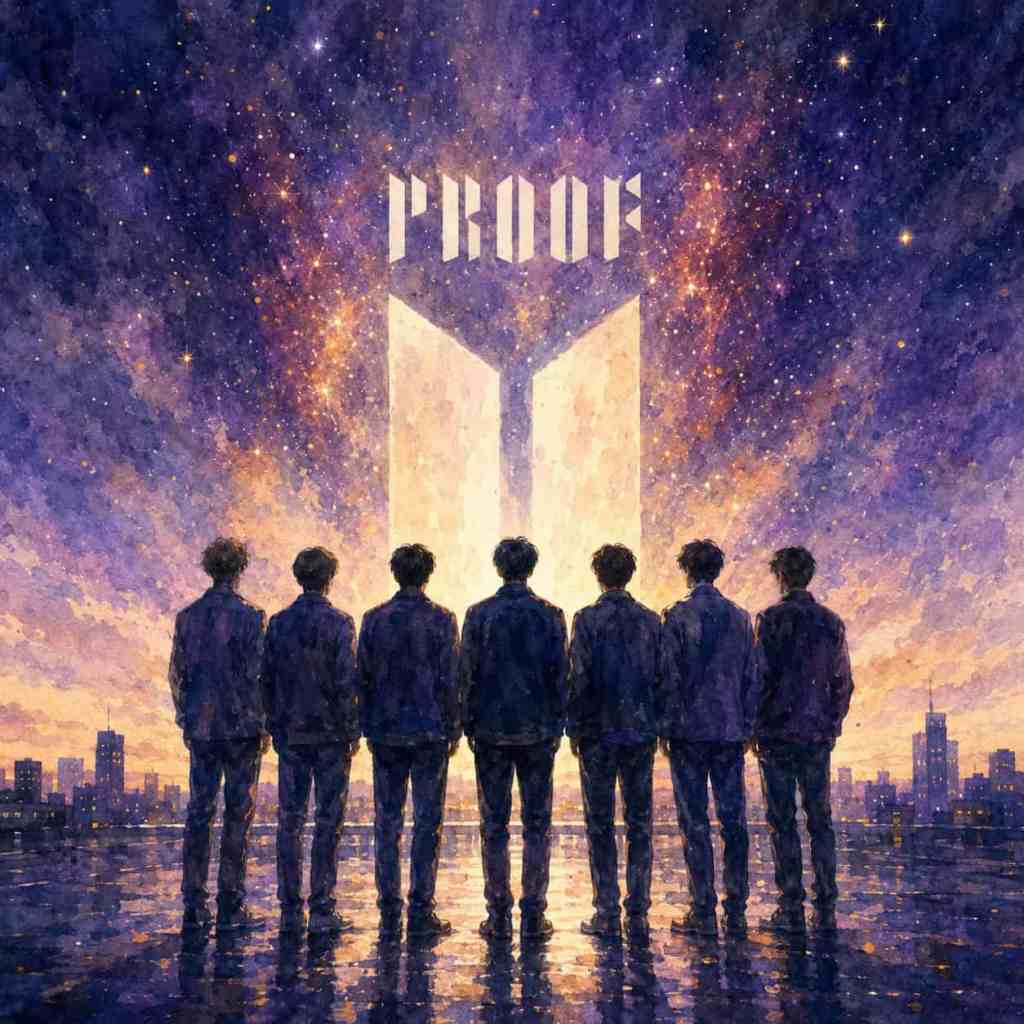
The solo era: seven voices outside the shared circle
The BTS solo era is not a side chapter. It is one of the most important tests of the entire group. It showed that the members are not just functions inside a group system, but individual artists with their own tastes, weaknesses, ambitions, and sounds. At the same time, it showed that going solo does not necessarily mean breaking apart. It can mean returning as stronger individuals.
j-hope opened this phase strongly with the album Jack in the Box, darker, sharper, and much less “sunshine” than someone who only knows his happiest side might expect. He showed that his hope has a shadow, rhythm, and dirt under its shoes. Jin came with “The Astronaut” and other solo work that builds more on emotion, vocals, and personal connection. RM released Indigo and later Right Place, Wrong Person, where the image of the leader as someone who always has the answer breaks down even further. He does not. And that is exactly why he is interesting.
SUGA, as Agust D, carried his raw personal line through D-DAY and a tour where rap, pain, work obsession, and introspection formed a very powerful shape. Jimin, in FACE, opened themes of insecurity, identity, and the reflection of one’s own face, later continuing into a more pop and sensual mode. V arrived with Layover, a jazzier, slower, stylistically distinct album that sounds like an old hotel, night rain, and a person who is not in a hurry because atmosphere is also a musical instrument. Jungkook, with Golden, stepped into the global pop arena as a soloist who can carry a hit, a performance, and mainstream pressure.
Together, the solo era showed one thing: BTS are not strong as seven because they hide one another. They are strong because when they separate, we can see how many different musical energies were always inside the group. And when they come back together, it is no longer the return of the same people to the same room. It is the return of seven more adult artists, each of whom has meanwhile gone through his own fire, his own mirror, and probably his own conversation with the inner manager of chaos.
Ruby Decibel comments: “The solo era was like a fashion show of inner demons. Everyone arrived in a different coat, but they all had perfect timing.”
Military service: a pause that was not empty
Military service is essential in the BTS story not only practically, but symbolically. The group had to pause full group activity, and the members gradually began their service. For the fandom, it was a period of waiting, counting down, nostalgia, and constant reassurance that this was not the end. Which is a brave sentence to repeat, but one still tends to hug the merch just in case.
At the same time, the pause was not empty. The members released solo music, prepared content, documentaries, projects, and maintained their relationship with fans. Meanwhile, the fandom functioned as an archive, memory machine, and emotional support unit. In the normal world, people wait for a bus. In the ARMY world, people wait for seven members to return from the military and in the meantime analyze old livestreams, charts, lyrics, hairstyles, and a random emoji in a post.
What matters is that the military hiatus came at a point when BTS no longer needed to prove they were successful. Instead, they had to prove something much harder: that their group identity could survive a period in which every member was living a different reality. And that is exactly what gives the return such weight. A return after a hiatus is not just a comeback. It is an answer to the question of whether seven people can find a shared rhythm again after each of them comes back slightly changed.
And with BTS, this tension is fascinating. Because their story has always been about growth. And growth means you cannot return exactly the same. You can come home, but home will sound different, because you sound different.
Babča comments: “It is like when children come back from boarding school. They are still themselves, but suddenly they have opinions, a suitcase, and a different way of opening the fridge.”
The return: what a comeback after the solo era means
BTS’ return after the solo era and military service is not an ordinary comeback. It is not just a new album, new styling, a new music video, new photos, and a fandom heart attack across multiple time zones. It is a major cultural test. What happens when a group that reached a global peak splits into seven solo paths for several years and then tries to assemble itself again?
This may be the most interesting phase of their present. Not because we should expect the old BTS to return. That would be a mistake. The old BTS no longer exist, just as the old version of any of us no longer exists, even if we still have the same mugs at home and occasionally the same hoodie. The question is not whether they will return to the past. The question is what a group will sound like after individual growth, military hiatus, solo albums, and several years of distance from full group performance.
And here lies enormous potential. Because BTS can now combine two things: the group chemistry that made them exceptional, and the more mature individual voices that grew during the pause. If that works, the new chapter does not have to be a nostalgic repetition of the past. It can be something more interesting: a return without retreating.
Lola comments: “I do not want BTS to return as a museum of themselves. I want them to walk in, hit the table, and say: yes, it is us, but we have gone through fire, the military, solo albums, and a few thousand group therapy sessions disguised as interviews.”

Why BTS rewrote pop culture
BTS did not rewrite pop culture only because they were successful. There have been many successful groups. They rewrote it through the way they connected several things that had often existed separately before: idol performance, authorial voice, social media, fandom organization, thematic continuity, global accessibility, and Korean identity without needing to fully adapt themselves to the Western market.
Their career showed that non-English music can enter the global mainstream if it carries enough emotional transfer and has a community that helps overcome the language barrier. It showed that fans are not only buyers, but distributors of meaning. They translate, explain, archive, create context, defend, and criticize. ARMY is not just a fandom as a crowd. It is a network. Sometimes beautiful. Sometimes wild. Sometimes more efficient than a medium-sized institution with a grant.
BTS also changed the perception of what an idol group can explore thematically. School, dreams, pressure, mental health, identity, self-love, the shadow of fame, burnout, the longing for peace, the fear of losing passion. Of course, they were not the only artists in the world to speak about these things. But they managed to carry them into a huge pop framework and make them part of mainstream conversation.
And then there is one more thing: their group dynamic. BTS are not just a music catalog. They are a relational structure. Seven personalities who balance each other, argue, support each other, laugh, grow, and occasionally look like a family gathering where someone accidentally played philosophy through the speakers. People do not connect to them only through songs. They connect to them through development.
Orla Křen comments: “Pop culture usually tries to manufacture idols. BTS accidentally manufactured a process. And a process cannot be put in a display case, because it keeps climbing out.”
Where to start if you want to understand BTS
Starting with BTS can feel a little intimidating, because their mountain of content looks like something between a library, a series, a discography, a reality show, a personal diary, and a fandom initiation ritual. But you do not have to start with everything. Quite the opposite. Start with the main axis. Do not crawl into the entire archive at once, or three days later they will find you under a blanket whispering “just one more Bangtan Bomb.”
For early energy, play “No More Dream,” “N.O,” “Boy in Luv,” and “Danger.” For HYYH, go to “I Need U,” “Run,” “Save Me,” and “Fire.” For the emotional turning point, “Spring Day.” For darker symbolism, “Blood Sweat & Tears” and “Black Swan.” For global pop, “DNA,” “Boy With Luv,” “Dynamite,” and “Butter.” For a group summary, “Yet To Come.” And to understand the members, it is worth going into the solo albums, because there you suddenly hear how different the colors are that BTS holds together.
The point is not to know everything. The point is to understand the current. BTS begin as a young group speaking about pressure and dreams. Then they dive into the pain of youth, temptation, loss, self-love, identity, shadow, pandemic exhaustion, recap, and solo growth. And now they stand in another phase: return after transformation.
That is why BTS are not just “the ones who had Dynamite.” That is like saying a cathedral is a pretty good window holder.
Lola comments: “Start with one song. Then one video. Then one member. Then suddenly you know what HYYH means, why everyone cries over Spring Day, and how it is possible for a person to have an opinion about the color of a microphone. Welcome.”
Conclusion: why the story keeps going
BTS began as a group from a small agency with no certainty that they would break through at all. They moved through school rebellion, hip-hop foundations, the pain of youth, symbolic darkness, a global turning point, self-love, the psychology of identity, the shock of the pandemic, English-language hits, a recap of the first chapter, the solo era, military service, and a return to themselves as a group.
This is not a straight road. It is a road with detours, losses, pressure, commercial paradoxes, fandom power, huge records, and human moments that sometimes proved more important than numbers. BTS did not become a phenomenon because they were perfect. They became one because people could watch them change. And in that change, they recognized their own lives.
Their story is not just about seven people conquering the world. That would be grand, but a little flat. It is more a story about seven people who grew under the pressure of the world and still tried not to lose their voice. Sometimes through rap. Sometimes through dance. Sometimes through humor. Sometimes through silence. Sometimes through a song that sounds like a light in a room where no one has opened a window for a long time.
Orla Křen comments: “Seven voices, many chapters, one ritual of return. And somewhere in between, a fan who only wanted to play one song.”
And that may be the most accurate summary of BTS. A person thinks they are clicking on a music video. In reality, they are opening a map. They do not know how many layers it has, how many roads branch from it, or how many times they will return to it. But one day they realize they are no longer dealing only with music. They are dealing with the path those people walked. And maybe, a little, with their own.
BTS from the beginning to the present are not a closed story. They are a phenomenon that keeps rewriting itself.
And that is exactly why they are not finished yet.
Lola, finally: “And now take a break. Drink some water. Stretch your neck. And do not say you will watch just one video. We all know what that lie looks like.”
When did BTS debut?
BTS debuted on June 13, 2013 with the single album 2 Cool 4 Skool and the title track “No More Dream.” Their beginning was strongly influenced by hip-hop, school pressure, rebellion, and the question of whether the dream a person follows truly belongs to them.
Which agency did BTS come from?
BTS were formed under Big Hit Entertainment. At the time, Big Hit was much smaller than the major Korean entertainment companies, which is one reason the BTS story is so distinctive: it was not an obvious rise from a huge corporate background, but a long growth built through work, fandom, social media, and a strong group identity.
What does HYYH mean in BTS?
HYYH stands for Hwa Yang Yeon Hwa, Korean 화양연화. In English, this era is called The Most Beautiful Moment in Life. In BTS’ work, however, it is not a pink idyll, but the beauty of youth that hurts because it is fragile, intense, and temporary.
How do you pronounce HYYH?
HYYH is most often read letter by letter in English: H-Y-Y-H. The full Korean title Hwa Yang Yeon Hwa can be roughly pronounced as “hwa-yang-yeon-hwa.”
Why is the HYYH era so important?
The HYYH era is important because BTS moved from school rebellion toward deeper themes of youth, loss, friendship, escape, uncertainty, and pain. This is where their visual language, symbolism, and the sense that each era is not just an album but a chapter in a larger story became much stronger.
Why is the HYYH era so important?
The HYYH era is important because BTS moved from school rebellion toward deeper themes of youth, loss, friendship, escape, uncertainty, and pain. This is where their visual language, symbolism, and the sense that each era is not just an album but a chapter in a larger story became much stronger.
What is the BTS school trilogy?
The BTS school trilogy includes 2 Cool 4 Skool, O!RUL8,2?, and Skool Luv Affair. This early phase explores school pressure, dreams, adult expectations, first love, and resistance against blindly fitting into someone else’s idea of life.
Why did BTS pause group activities?
BTS did not pause group activities because of a breakup, but because of a combination of solo growth, rest, a changing life stage, and the members’ mandatory military service. It was a transition into a new chapter, not the end of the group.
Which BTS members released solo projects?
All seven BTS members have released solo projects: RM, Jin, SUGA as Agust D, j-hope, Jimin, V, and Jungkook. Each showed a different musical color, from raw rap intensity and jazzier atmosphere to global pop.

Halloween and Remembrance of the Dead in Georgia: Two Different Traditions
Halloween in Tbilisi is a contemporary urban event. Georgian kelekhi belongs to funeral and memorial practice — it is neither Halloween nor one nationwide All Souls’ Day.


Why Do the Dead Return at the Turn of October and November? Halloween, Saints, Souls and One Very Tangled History
How did Samhain, All Saints, prayers for the dead, Irish turnips, guising and American pranks become Halloween with pumpkins, costumes and bags of candy?

Halloween, All Souls’ Day and Festivals of the Dead Around the World: A Big Guide to Traditions That Are Not the Same
Halloween, All Souls’ Day, Día de Muertos, Undas, Fèt Gede and giant Guatemalan kites: a guide to what happens around the world at the end of October and beginning of November — and why these traditions do not merge into one.