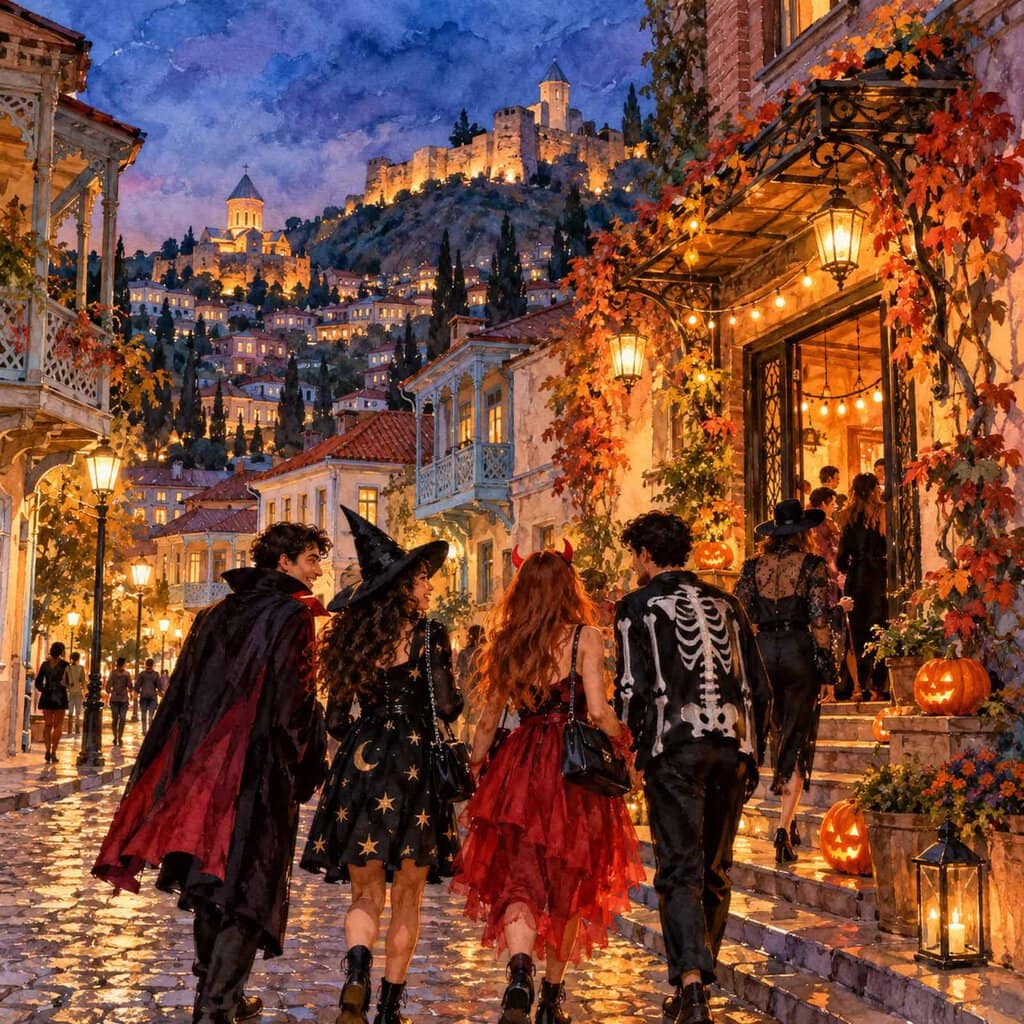
At the turn of October and November, Tbilisi performs a small calendar trick. On 31 October you can put on a black cloak, head out for Tim Burton, Danny Elfman and anything with enough candles to look suspicious. But the next day Georgian All Saints does not arrive. Nor does 2 November trigger a local copy of the Czech All Souls’ tradition. If we are patient, the dead really do make it into the calendar — just not until 7 November.
Georgia manages to turn one week into a compact lesson in cultural geography. Halloween can exist here as contemporary urban entertainment. The Western Christian calendar follows its own track. Georgian Orthodoxy has another rhythm. And into all of this steps Demetrius Saturday, a day of remembrance for the dead whose historical family tree is far more tangled than one might expect from a single November Saturday.
So if we want a simple answer to the question “What is Georgia’s version of All Souls’ Day?”, we have two options. We can invent something tidy and be done in five minutes. Or we can open the calendar and discover that reality is considerably more interesting.
31 October: Tbilisi is perfectly happy to borrow Halloween. Nobody asks for its birth certificate
Halloween is not an old Georgian holiday, which does not stop it from having a good time in present-day Tbilisi. Clubs, bars and cultural venues have been using 31 October for costume parties, themed nights and horror-flavoured programmes for years. And 2026 offers an almost comically perfect example: on 31 October, Vakhtang Salaridze Concert Hall is scheduled to host Tim Burton’s Universe by Candlelight, with music from the film worlds of Tim Burton and Danny Elfman.
So yes: the last evening of October in Tbilisi can contain candles, The Nightmare Before Christmas, Edward Scissorhands, costumes and a dark aesthetic. We do not need to invent a Celtic great-grandfather in the Georgian mountains to make this culturally interesting. A modern tradition is still a tradition of the present — it simply has a shorter résumé and probably an Instagram account.
Lola Tralala comments: A plastic bat in a Tbilisi bar proves that a Tbilisi bar has a plastic bat. We can turn it into a nationwide ethnographic study after the third chacha.
And that is much more interesting than the usual online dilemma: “Does Georgia celebrate Halloween — yes or no?” There is obviously no single answer for an entire country. Young people in Tbilisi, a family in a mountain village, an Orthodox parish and someone who could not care less about Halloween do not have to do the same thing on 31 October. A country is not a family group chat where someone writes at seven: “Right, everyone in costume at eight.”

1 November: we arrive for All Saints. Only about five months too late
Then the calendar rolls into November and anyone raised in Western Europe automatically thinks: All Saints. This is where we discover how dangerous it can be to translate not just words but dates. In the Orthodox tradition, the Sunday of All Saints is celebrated on the first Sunday after Pentecost. The Georgian church calendar for 2026 therefore places it on 7 June.
So if we land in Tbilisi on 1 November looking for a Georgian version of All Saints, the calendar might politely hand us our coat and explain: “We dealt with that in June.” Same Christian tradition, different liturgical rhythm. In one sentence, the comfortable idea that European calendars can simply be translated word for word disappears.
It is a small detail, but these details are what turn a cultural calendar into something more than a list of flags. All Saints is not a universal date glued to 1 November from Lisbon to Tbilisi. The same name can sit in a completely different part of the year — and there is nothing exotic about that to a local believer. It only feels exotic to us because we accidentally mistook our own calendar for the factory settings.

2 November: so where are Georgia’s All Souls?
On 2 November our expectations make another attempt. In the Western Catholic tradition comes the Commemoration of All the Faithful Departed — All Souls’ Day. Surely now the Georgian version must appear?
It does not have to.
Georgian Orthodox practice uses a different system for collective remembrance of the dead. During the year there are several memorial Saturdays and other days when the Church prays for the departed. So 2 November is not one giant nationwide switch that flips into “remember the dead” mode. Family memory continues, of course, along with funerals, anniversaries, grave visits and prayers — they are simply not all squeezed into our date. This is a good moment to stop searching for “Greek All Souls”, “Georgian All Souls”, “Korean All Souls” and every other relative we have adopted without asking. Sometimes a local culture really does have a close equivalent. Sometimes we have merely put a travel hat on a word and sent it abroad to cause trouble.
And then comes 7 November. The dead finally get their Saturday
In 2026, the Saturday before the feast of Saint Demetrius of Thessaloniki falls on 7 November. And here, in the Georgian church context, we meet Demetrius Saturday — a day identified with remembrance of the dead. Suddenly we really do have a November memorial day. It simply arrived five days later than expected and feels no obligation whatsoever to apologise.
The central meaning of such a day is prayer for the departed. This is also a good moment to slow down our constant urge to find one photogenic prop for every holiday. Sometimes the main symbol is not a pumpkin, bread, mask or enormous dragon. Sometimes the essential thing is simply a person’s name spoken in prayer. Slightly awkward for Pinterest. Entirely sufficient for the history of religion.
At the same time, we should not declare Demetrius Saturday “Georgia’s All Souls’ Day” and go happily to lunch. It is a specific element of the Orthodox calendar with its own history — and that history is exactly where the story becomes beautifully complicated.

Because Demetrius Saturday has a Russian birth certificate. Yes, this just got complicated
A Georgian church text devoted to Demetrius Saturday traces its origin to Russia and to the memory of warriors killed in the Battle of Kulikovo in 1380. The commemoration became associated with the feast of Saint Demetrius of Thessaloniki and the Saturday before it. What began as remembrance of fallen soldiers gradually developed in the Russian church environment into a broader day of remembrance for the dead.
Then Georgia, the Russian Empire and the nineteenth century enter the story. The same Georgian Orthodox source openly states that Demetrius Saturday began to be observed in Georgia when the country was part of the Russian Empire and the Georgian Church had temporarily lost its independence. Autocephaly was later restored, but Demetrius Saturday remained in church calendars.
Culturally, that is almost a perfect case study. We have a tradition that genuinely appears in the Georgian church calendar today. It is not invented. It is not “less real” because it travelled. But it would be equally wrong to attach the label “ancient Georgian custom” and add mountain flute music.
Lola Tralala comments: Traditions migrate too. They simply do not fill in a “country of origin” form at the border, so two centuries later everyone looks surprised.
Even more interestingly, Georgian Orthodox priest Andria Kemularia, whose text on Demetrius Saturday is published by Orthodoxy.ge, himself questions this origin and asks what meaning a day originally connected with Russian military history has for Georgians. That is a valuable reminder: even within one religious tradition, every inherited custom is not interpreted in the same way. Cultural heritage is not a cupboard where someone placed the porcelain once and everybody obediently claims to like it for the next two hundred years.

So do Georgia’s dead wait until a November Saturday? Not remotely
Demetrius Saturday is only one point in the calendar. Georgian practices of remembering the dead are much broader. A funeral may be followed by a memorial feast called kelekhi; there are family anniversaries, prayers and regionally varied ways of visiting graves. Ethnographic work from particular areas also records the fortieth day after death, annual commemorations and traditions of lamentation. All of this matters, but in our autumn article it remains background: proof that relationships with the dead do not live on only one day of the year.
And then there is spring. After Orthodox Easter, highly visible family visits to cemeteries take place in Georgia, associated in different places with red eggs, food, candles and other practices. We are not going to cram all of that into an article about the end of October simply because the dead have poor respect for our editorial categories. Easter Georgia deserves its own spring story — and we will return to it properly.
For now it is enough to know that Georgian remembrance of the dead is not one holiday. It is a network of family, liturgical and local rhythms. Demetrius Saturday is one thread. Kelekhi another. Spring cemetery visits another. And Halloween? Meanwhile, it is having fun at a completely different table in Tbilisi.

Eight days in Tbilisi and three different calendars
Put the week back together and it becomes almost comic. On 31 October, Tbilisi can offer modern Halloween, a Tim Burton concert or a costume night. On 1 November, we arrive with Western All Saints and discover that the Orthodox calendar celebrated it on 7 June. On 2 November, we bring the idea of All Souls, which also refuses to fit neatly. And on 7 November, we finally encounter Demetrius Saturday, an actual church day of remembrance for the dead — with a historical detour through medieval Russia and the nineteenth century.
This is one of those moments when cultural history looks much more realistic than tidy summary tables. Traditions do not sit in separate clean boxes. They travel. They arrive with churches, empires, migration, films, concerts and the internet. Some take root. Some change meaning. Some become so ordinary that hardly anyone thinks about their origins anymore.
And then a BeadCulture editor arrives and starts poking around in their birth certificates.

So does Georgia have All Souls’ Day or not?
Not in the form familiar from Western Europe on 2 November. And that is not a deficiency we need to fix by finding a sufficiently similar custom. Georgian Orthodox practice has its own days of collective prayer for the dead, and in November 2026 one of them is Demetrius Saturday on 7 November. Family remembrance also has other dates and forms throughout the year.
At one end of our eight-day story stand Tim Burton, candles and modern Tbilisi. At the other are prayers for the dead, the Saturday before the feast of Saint Demetrius and a tradition that reached Georgia along a historical route far too complicated to fit on one Halloween poster.
And between them lies exactly what we love about cultural calendars: the moment when we arrive looking for a simple answer and find a better story instead.

FAQ: Georgia between Halloween and Demetrius Saturday
Is Halloween celebrated in Georgia?
Yes, especially in Tbilisi, where Halloween parties, concerts, costume events and other pop-culture programmes appear. It is a contemporary urban layer, not an ancient nationwide Georgian holiday.
Is All Saints on 1 November in Georgia?
Not in the Georgian Orthodox tradition. The Sunday of All Saints falls on the first Sunday after Pentecost. In 2026 the Georgian church calendar places it on 7 June.
Does Georgia have All Souls’ Day on 2 November?
Not as a direct equivalent of the Western Catholic Commemoration of All the Faithful Departed. The Orthodox calendar has its own collective days of remembrance for the dead spread throughout the year.
What is Demetrius Saturday?
It is the Saturday before the Orthodox feast of Saint Demetrius of Thessaloniki, identified in the Georgian church calendar as a day of remembrance for the dead. In 2026 it falls on 7 November.
Is Demetrius Saturday an originally Georgian tradition?
No. A Georgian Orthodox source connects its origin with the Russian tradition of remembering warriors killed at Kulikovo in 1380. According to that source, it entered the Georgian church environment in the nineteenth century during Russian rule and remained in the calendar after the restoration of Georgian church autocephaly.
What about Easter cemetery visits?
They are very important in Georgian relationships with the dead, but they belong to another seasonal story. A spring article will look at cemetery visits after Orthodox Easter, red eggs, family gatherings and regional variations.
🧵 Where the threads lead
Orthodoxy.ge — church calendar 2026 — for the date of the Sunday of All Saints in 2026 and the rhythm of the Georgian Orthodox calendar.
Orthodoxy.ge — Demetrius Saturday — for its identification as a day of remembrance for the dead, its link with the Battle of Kulikovo, its Russian origin and its arrival in Georgia in the nineteenth century.
Eventebi.ge — Tim Burton’s Universe by Candlelight, 31 October 2026 — a concrete contemporary example of Halloween and horror-fantasy pop culture in Tbilisi on 31 October 2026.
Georgia Travel — Easter Traditions — used only to indicate spring cemetery visits briefly; they will be explored in a separate Easter article.
📚 Want to go deeper?
The autumn week is only one part of Georgia’s story. In spring we will return to the period after Orthodox Easter, when remembrance of the dead moves into cemeteries in a very different way — with family visits, red eggs, food and local customs that deserve their own article rather than three sentences squeezed between a pumpkin and Demetrius Saturday.

Autumn Equinox in Laos: Ancestors Have Their Time, and the Mekong Has Plans of Its Own
In a Czech September, one glimpse of the first horse chestnut is enough to make you mentally reach for a sweater. Bringing that version of autumn to Laos, however, would mean arriving at the meeting not only in the wrong clothes but probably with the wrong calendar too. September here has other business: gifts are…

Autumn Equinox in Vietnam: Children Carry Lanterns, the Moon Runs the Festival, and the Rain Still Doesn’t Ask Anyone About September 23
If September in Vietnam were run by one large central office, the meetings would be a disaster. The Sun would arrive with a spreadsheet and announce that astronomical autumn begins on September 23. The Moon would barely have sat down before replying, “Lovely. Trung Thu is on the twenty-fifth this year.” Rice in the northern…
Autumn Equinox in Czechia: Mabon, Harvest Festivals, Hops, Wine — and an Autumn That Refuses to Follow One Calendar
Autumn has a small organizational problem in Czechia. Astronomers say it begins with the equinox. Meteorologists, for statistical purposes and with very little drama, switch it on as early as 1 September, because tables like order even when the weather clearly does not. Farmers can look over both groups’ shoulders and politely note that this…