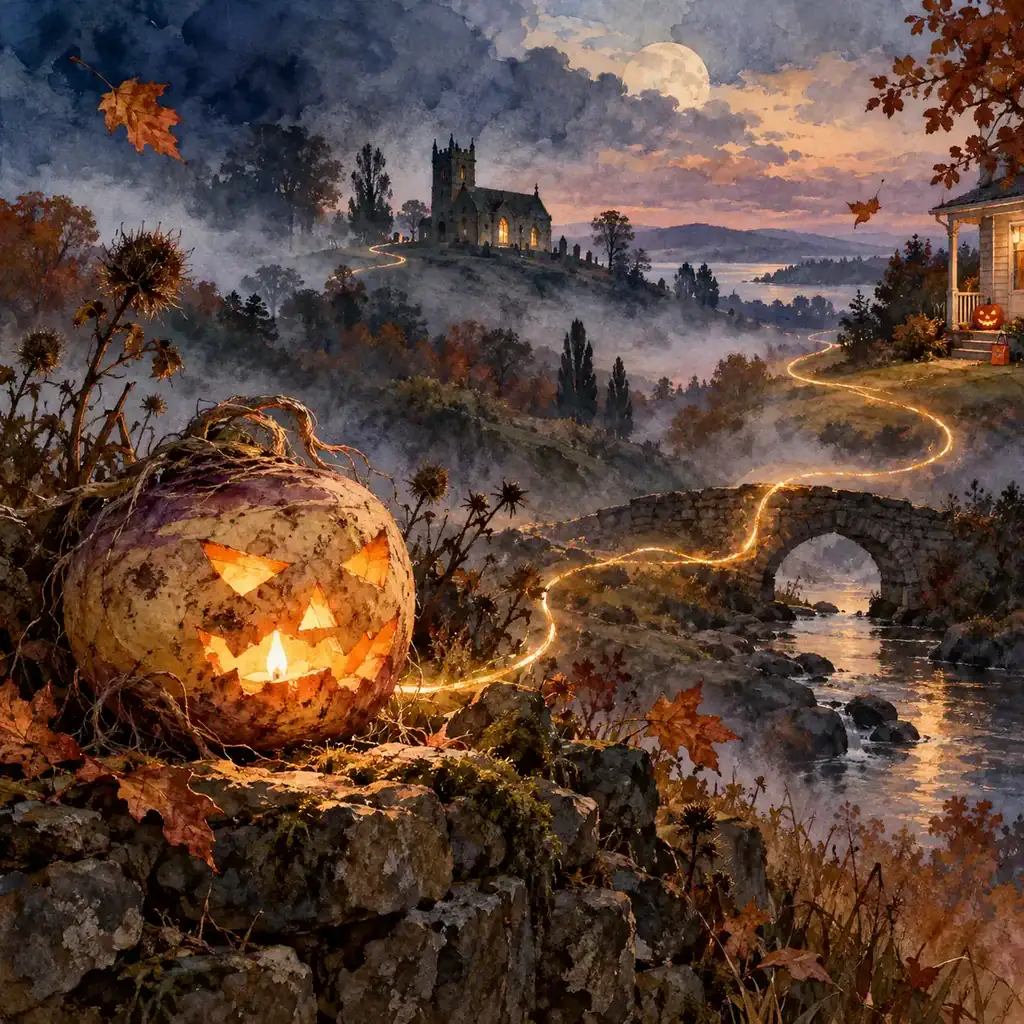
If Halloween had a birth certificate, it would look like a document that had survived a flood, a fire, several house moves and one extremely creative registrar.
Place of birth? Ireland? Scotland? Rome? A French monastery? The United States? Date of birth? Sometime before Christianity? The eighth century? The eleventh? The nineteenth? The 1950s?
Mother? Samhain. Father? All Saints. Relatives? All Souls, souling, guising, terrifying Irish turnips, American pumpkins, fortune-telling about future husbands, neighborhood vandalism, the candy industry and Donald Duck.
In short, Halloween is not a holiday with a neat family tree. It is a cultural patchwork that has been resewn, torn apart, carried across the Atlantic, fitted with a few new pieces and finally shipped back to Europe with a pumpkin under one arm and a bag of individually wrapped candy under the other.
And that is exactly why its history is so good.
First, the bad news: there was no single moment when “Halloween was born”
When you read that “Halloween began 2,000 years ago as the Celtic festival of Samhain,” it is a usable shortcut in roughly the same way that saying the smartphone began with the invention of the telephone is usable. Yes, there is a genealogy. But an awful lot happened between the two ends of the story.
Modern Halloween contains elements linked to older Gaelic seasonal traditions, the medieval and early modern Christian calendar, European house-visiting customs, Irish and Scottish folk culture, migration to North America, urban mischief, twentieth-century mass culture and commercial industry.
So instead of inventing one great-grandfather responsible for everything, we will follow the separate threads. Historical family trees are messy. Halloween’s birth certificate clearly says: father not stated, extended family enormous.
Samhain: the moment summer ends and nature stops being friendly
The oldest important thread leads into the Gaelic world, especially Ireland. Samhain was one of the major seasonal thresholds of the traditional Irish year. It fell at the beginning of November and marked the entry into the winter half of the year; as with other important calendar days, much of the activity began the previous evening. Irish folklore collections record 31 October, Oíche Shamhna, as a night of feasting, games, disguises, divination and ideas about the movement of the dead and other supernatural beings.
And, really, that makes very human sense. Imagine northwestern Europe without electric lighting, central heating, a supermarket open until ten and an app telling you the sun will set at 4:47 p.m. Most of the harvest is under cover. The days are shortening dramatically. Winter, cold and uncertainty are arriving. The landscape that spent all summer producing food has just pulled down the shutter.
The calendar boundary between summer and winter was therefore not just a poetic line in a diary. It was practical. And boundaries have one interesting habit in folklore: they tend to let strange things through.
Medieval Irish texts really do connect Samhain with moments when the human world and the Otherworld come dangerously close. But this is where we need to keep one foot on the historical brake: those texts are medieval, written long after Ireland had been Christianized. When we reconstruct pre-Christian Samhain, we do not have a reporter standing beside a fire in 200 BCE announcing, “Yes, I have now verified three masks and one ghost.”
We have later written sources, language, archaeology and folklore traditions. We have traces. We do not have CCTV.
Lola Tralala comments: The moment somebody begins a sentence with “The Celts believed exactly…”, Lola automatically starts looking for the footnote. Sadly, the Celts left us no PowerPoint titled “Samhain: objectives, KPIs and communication with the dead.”

Were they even “the dead”?
Yes — but not only them. This is one place where modern Halloween tidies up the older picture a little too much. In Irish tradition Samhain was not simply a “Day of the Dead.” It was associated with otherness, danger, the future, divination, beings of the Otherworld, protection of the home, winter and the disruption of ordinary order.
Folklore material includes the dead, but also the púca, fairies and other supernatural beings, divination games and various ways of getting through the night without being carried somewhere for which you definitely did not have a reservation.
So the modern phrase “the veil between the living and the dead grows thin” captures part of the tradition, but it is almost too tidy. The older world was considerably less disciplined in its administration. Grandma and Grandpa were not necessarily the only ones waiting beyond the boundary. It could have been anything.
Which, admittedly, is much worse news.
Then the Christians arrived. And no, we do not have minutes from a meeting titled “Let’s steal Halloween from the Celts”
Here begins one of the internet’s favorite stories: the Church saw pagan Samhain, decided to destroy it and moved All Saints to 1 November.
Elegant. Possibly a little too elegant.
Collective Christian commemorations of martyrs and saints existed long before 1 November became the dominant Western date, and different Christian centers observed them at different times of the year. We know of commemorations of all martyrs in late antiquity, Eastern traditions after Pentecost and a Roman May commemoration associated with the Pantheon, which Pope Boniface IV dedicated to the Virgin Mary and all martyrs in the early seventh century.
And now for an inconvenient but beautiful historical sentence: we do not know exactly why 1 November became the established date in Western Christianity.
In the eighth century Pope Gregory III dedicated a chapel in St Peter’s Basilica to all saints. By the late eighth and early ninth centuries a November feast is attested in Western Europe, and during the ninth century 1 November became further established as All Saints’ Day. Scholarly literature still notes, however, that the origin of the November date is not explained with certainty.
Could contact with Gaelic traditions have played a role? Possibly, and cultural overlap is undeniable. But can we confidently say that somebody in Rome slammed a fist on the table and announced, “We need to eliminate Samhain; open the calendar”?
No. History did not send us that memo.
Lola Tralala comments: People are surprisingly fond of imagining the medieval Church as a marketing agency: “Clients, the pagans are taking our Q4. Move the saints to November.” Reality, unfortunately, is less PowerPoint-friendly and much more tangled.

And by the way: the word Halloween itself is Christian
This is one of the loveliest paradoxes in the whole story. You can have a festival full of older Gaelic motifs, ghosts, divination and disguise — while using a name derived directly from the Christian calendar.
Hallow meant a saint or something holy. All Hallows means All Saints. The evening before their feast was All Hallows’ Eve, which gradually became Halloween.
So when somebody announces on 31 October that Halloween “has absolutely nothing to do with Christianity,” the word itself stands in the corner and coughs awkwardly.
Its name literally points to the evening before All Saints. That does not mean, of course, that all its customs are Christian.
Welcome to cultural history. Please leave your simple answer at the coat check.

1 November belongs to the saints. On 2 November the rest of the dead finally get a day of their own
All Saints is not the same thing as remembering all the dead. That is another layer.
Prayers for the dead existed in the Christian world long before there was one universal November day. Different monasteries and regions had their own dates. A major impulse, however, came from Cluny in Burgundy, one of the most influential monastic centers of medieval Europe.
Abbot Odilo of Cluny introduced a special commemoration of all the faithful departed on 2 November throughout his monastic network. The precise dating of this step varies in the literature, but the subsequent development matters more: the Cluniac custom spread to other monasteries and gradually through the Western Church.
And suddenly we have a neat trio: 31 October — the evening before All Saints. 1 November — All Saints. 2 November — all the faithful departed.
Three neighboring days. Three different historical layers. And roughly a million future internet articles destined to turn them into one thing.
How do we get from prayers for souls to children ringing doorbells?
Slowly. And above all by several routes at once.
In medieval and later Britain there were house-visiting customs often associated with the word souling. Poor people, and later children as well, could go from house to house and receive food — traditionally the so-called soul cakes — in exchange for prayers for deceased members of the household.
In Ireland and Scotland, meanwhile, traditions of guising developed: disguised visitors went from house to house and offered a song, rhyme, joke or small performance in return for food or another reward. Folklore collections record groups of masked people or children visiting neighbors and entertaining the household.
Notice the structure. I come to your door. I do something. You give me something.
We are beginning to recognize our future little Batman with the plastic bucket.
But again, a straight line from “souling → trick-or-treat” is too simple. Folklorists discuss several possible predecessors of American trick-or-treating, including guising, souling and other European and North American masked visiting customs. Halloween once again refuses to settle for a single parent.
And the costumes? They were definitely not invented by a polyester store
Disguise is documented in Irish and Scottish tradition long before today’s costume industry. A mask could hide a person, frighten the neighbors, allow someone to behave differently from an ordinary day and belong to a night when the normal order was not entirely reliable.
And here we find one of Halloween’s most durable principles: for one night, you can be somebody else.
A ghost. An animal. A monster. A celebrity. A vampire. Barbie. An inflatable dinosaur.
Human civilization has come a long way, but the opportunity to walk down the street as a three-meter banana apparently remains one of its permanent needs.

Pumpkins? First comes the turnip. And it is not pretty
If there is one object that instantly says “Halloween,” it is a hollowed orange pumpkin. Old Irish Halloween would probably look at that pumpkin and ask, “What is that?”
In Ireland, frightening lanterns were carved from turnips and other root vegetables. The National Museum of Ireland preserves a famous example associated with Fintown in County Donegal. A candle was placed inside the hollowed turnip and the carved face was meant to give people a proper fright. The museum explicitly links today’s pumpkin lantern with the American continuation of this older tradition.
Once you see that Irish turnip demon, it becomes clear that the pumpkin was not cultural decline. It was a user-interface improvement.
Bigger. Hollower. Easier to carve. A pleasant color. And most importantly, after half an hour of work you still have all your fingers.
Lola Tralala comments: The pumpkin is not an ancient Celtic symbol of Halloween. The pumpkin is the American redesign of the turnip. Same product, better UX.

Then migration arrives and Halloween gets a boat ticket to America
During the nineteenth century millions of people left Ireland for North America, especially during and after the Great Famine. According to the Library of Congress, approximately 4.5 million Irish people entered the United States between 1820 and 1930 alone. Languages, songs, recipes and beliefs travel with people — and so do calendar customs.
Irish and Scottish traditions therefore found themselves in a new environment. And this is exactly where Halloween begins doing what it does best: mixing.
In North America it met local autumn celebrations, home parties, disguises, jokes and the traditions of other immigrant communities. Gradually it ceased to be merely a custom of particular groups and became a more conspicuous American seasonal holiday.
But Halloween around 1900 might disappoint an eight-year-old today. Candy was not yet the main character.

Halloween around 1900: fewer Snickers, more “will I finally get a husband this year?”
Yes. Halloween was also surprisingly romantic.
Around the turn of the twentieth century, Halloween parties in the United States often featured fortune-telling about future partners and marriage. Historical newspapers and Library of Congress collections preserve instructions in which young women used apples, mirrors, nuts, water and other props to discover whom they would marry.
Which is a lovely reminder of how quickly a holiday changes.
Halloween today: “I’m Wednesday Addams.”
Halloween around 1910: “If I walk backward to the well and look over my left shoulder, will my future husband appear?”
Humanity apparently always needed horror. Only the subject changed.

Then the children decided cultural heritage needed a little vandalism
Halloween had a long and extremely lively American tradition of pranks. And by prank we do not mean merely ringing a doorbell and running away.
Historical sources from the late nineteenth and early twentieth centuries describe overturned barrels, dismantled wagons, painted windows, damaged property, false alarms and other jokes beside which today’s “haha, we put toothpaste on the neighbor’s door handle” feels like an administrative meeting.
In cities, Halloween disorder became enough of a nuisance that communities began promoting organized parties and children’s activities. The older model of “we’ll destroy your fence” gradually gave way to the safer arrangement of “we’ll give you something nice; will you please go home now?”
And this is where the system we know as trick-or-treat begins to gather strength.
“Trick or treat” is not a medieval formula. It is younger than it looks
The visiting customs themselves are older. But the phrase trick or treat and its modern social arrangement are surprisingly young.
The expression appears in North American newspapers in the 1920s. American trick-or-treating developed more strongly during the 1930s and became a truly mass children’s tradition mainly in the following decades.
That is worth repeating. Today, a masked child with a candy bag can look like the oldest form of Halloween. In fact, it is one of its younger mutations.
So an ancient Celt probably did not walk around the village saying, “Give me a Twix or I’ll soap your window.”
That is a twentieth-century cultural innovation.
And even the candy was not there for very long
Another blow to eternity: Halloween was not always a candy holiday.
Even in the first half of the twentieth century children could receive fruit, nuts, coins, homemade baked goods, small toys or other gifts on their rounds. Candy did not truly dominate American trick-or-treating until after the Second World War, especially in the 1950s and 1960s.
Several things helped at once. Postwar suburbanization created neighborhoods full of families and houses that were easy to visit. Trick-or-treat offered a socially acceptable way to tame the older tradition of mischief. Radio, magazines, television and film showed the same model to millions of people. Candy manufacturers discovered that there was an evening when the entire United States voluntarily tried to pour sugar into children’s bags.
And the marketing department probably spent a quiet moment weeping with happiness.
In 1952 Disney even released the short film Trick or Treat, starring Donald Duck and his nephews. Pop-culture images like these helped normalize the new ritual nationwide.
Lola Tralala comments: Old Irish people: “Careful, the Otherworld may open tonight.” America, 1955: “Understood. How many mini chocolate bars should we order?”
And America is the place that makes the Halloween we can recognize from three meters away
During the second half of the twentieth century the ingredients finally began assembling into the picture we know well: the pumpkin jack-o’-lantern, children’s costumes, spooky decorations, trick-or-treat, horror films, adult parties, witches, skeletons, bats, ghosts and individually wrapped candy.
And gradually, an enormous seasonal industry as well.
Some parts are centuries old. Some are decades old. Beside the mask and the ghost, whose ancestry runs deep into European folklore, sits a plastic cup with the logo of a film franchise manufactured last month.
And somehow they do not argue.
Halloween has an extraordinary talent for absorbing anything it touches.
Then something historically very funny happens: Halloween crosses the Atlantic again
European traditions helped create American Halloween. America rebuilt it. Then, through films, television series, music, retail chains, the internet and pop culture, it began exporting it back to Europe — and onward around the world.
So the modern cultural route looks approximately like this:
Europe → America → blender → pumpkin → television → Europe, please sign for delivery.
That is why Halloween parties now appear in countries with almost no historical connection to Samhain.
Halloween no longer needs a shared origin. Wi‑Fi will do.

So why do “the dead return” specifically at the end of October?
Now we can finally answer the question in the title.
Partly because, in the Gaelic agricultural calendar, the beginning of November was a major seasonal threshold: entry into the winter half of the year. Transitional moments are strikingly often associated in folklore with disrupted boundaries, the supernatural and divination. Samhain therefore contributed a powerful layer of stories about the Otherworld, spirits and a dangerous night.
Beside it gradually settled the Western Christian calendar, with All Saints on 1 November and the commemoration of the dead on 2 November. Their precise historical relationships, and the reasons those November dates were chosen, follow complicated and partly uncertain paths. Over the centuries these layers touched, influenced and mixed with one another.
That does not mean every autumn tradition concerning the dead around the world comes from Samhain. Quite the opposite. Human societies remember their dead at many different times of year and for very different historical reasons. Mexico’s Día de Muertos has its own complex history; other cultures hold memorial days in spring, summer or according to lunar calendars.
The dead, in short, do not follow one global calendar.
Which is sensible of them. They already have enough paperwork.
So what remains of old Halloween?
Surprisingly much: disguise, disruption of ordinary order, a night full of uncertainty, food, games, divination, house visits, jokes, fire and light, ghosts — and above all the idea that once a year we can treat the boundary between safety and danger a little differently from usual.
But almost none of these elements survived the centuries inside a glass case. Their meanings changed. A mask could protect or frighten, later entertain the neighbors, and today turn you into Shrek for three hours. A house visit could mean a prayer, a performance or a small threat to property; today it means candy. The lantern moved from turnip to pumpkin. Remembering the dead met pretending to be dead. A religious eve also became a huge secular holiday.
And that is the real historical miracle of Halloween.
Not that it survived unchanged.
It survived precisely because it never stopped changing.
If we placed an Irish turnip from 1900, a medieval All Saints calendar, a soul cake, a child’s mask, a bag of candy and a plastic supermarket pumpkin on a table today, they would not look like one tradition.
And yet a thread runs between them. Not straight. Not clean. Not always perfectly documented. But it is there.
And somewhere at the end of it stands a child dressed as a dinosaur asking for chocolate.
History occasionally knows how to land a punchline.
Find more holidays, rituals and calendar oddities in our cultural calendar of world holidays and rituals and in our overview of holidays and important days by region.
FAQ
Did Halloween come from Samhain?
Samhain is one of the most important historical layers of Halloween, especially through Irish and Scottish traditions. But modern Halloween is not simply a preserved Samhain. It emerged through a long interweaving of Gaelic traditions, Christian Allhallowtide, European disguise and visiting customs, and later American developments.
Did the Church move All Saints to 1 November because of Samhain?
Such a straightforward story is not documented. Collective feasts of martyrs and saints existed in different Christian regions and on different dates. The origin of the Western date of 1 November remains partly unclear in scholarly literature.
Why is Halloween celebrated on 31 October?
Because it is the eve of 1 November, All Saints’ Day — hence the name All Hallows’ Eve, from which Halloween developed. At the same time, the eve of 1 November corresponded to the traditional Irish evening before Samhain.
Where did Halloween pumpkins come from?
From a European tradition of carving root vegetables, especially Irish turnip lanterns. After the tradition moved to North America, the larger and more practical pumpkin took their place.
Is trick-or-treat an ancient Celtic tradition?
Not in its modern form. It may have predecessors in souling, Irish-Scottish guising and other visiting customs, but the phrase and standardized American practice of trick-or-treat appear only in the twentieth century and spread widely especially after the Second World War.
Did children always eat candy at Halloween?
No. In the first half of the twentieth century children also received fruit, nuts, coins, baked goods and small gifts. Candy came to dominate American trick-or-treating especially from the 1950s onward.
🧵 Where the threads lead
National Museum of Ireland — Halloween / Samhain — key source for the Irish seasonal calendar, disguise, games, divination and the folkloric shape of Halloween night.
National Museum of Ireland — Ghost Turnip — for Irish turnip lanterns and their relationship to later American pumpkins.
University College Cork — Secrets at Samhain — for medieval Irish texts connecting Samhain with the Otherworld, supernatural beings and divination.
Encyclopedia of Catholicism — All Saints and Catholic Encyclopedia — All Souls’ Day — for the development of All Saints, uncertainty around the origin of the 1 November date and the spread of the November commemoration of the dead from the Cluniac world.
Library of Congress — The Origins of Halloween Traditions and Irish-Catholic Immigration to America — for souling, guising, the rise of trick-or-treat and the migration of Irish traditions to the United States.
Smithsonian — When Halloween Was All Tricks and No Treats and A Cultural History of Candy — for American pranks, the growth of trick-or-treating and candy becoming Halloween’s main currency.
📚 Want to go deeper?
Jack Santino (ed.), Halloween and Other Festivals of Death and Life — a folkloristic collection tracing Halloween, festivals of the dead and their social and material transformations.
Lisa Morton, Trick or Treat: A History of Halloween — a detailed history of Halloween, its journey to America and later global spread.
Library of Congress — Halloween & Día de Muertos Resources — a gateway to historical newspapers, photographs, folklore material and other sources for deeper research.
Autumn Equinox in Vietnam: Children Carry Lanterns, the Moon Runs the Festival, and the Rain Still Doesn’t Ask Anyone About September 23
If September in Vietnam were run by one large central office, the meetings would be a disaster. The Sun would arrive with a spreadsheet and announce that astronomical autumn begins on September 23. The Moon would barely have sat down before replying, “Lovely. Trung Thu is on the twenty-fifth this year.” Rice in the northern…
Keep reading
Autumn Equinox in Czechia: Mabon, Harvest Festivals, Hops, Wine — and an Autumn That Refuses to Follow One Calendar
Autumn has a small organizational problem in Czechia. Astronomers say it begins with the equinox. Meteorologists, for statistical purposes and with very little drama, switch it on as early as 1 September, because tables like order even when the weather clearly does not. Farmers can look over both groups’ shoulders and politely note that this…
Keep reading 
September Equinox Around the World: Autumn in the North, Spring in the South — and Why That’s Not the Whole Story
Sometime around the end of September, the internet starts behaving as if the planet has been issued a single dress code. Leaves. Pumpkins. Cinnamon. Candles. A burgundy sweater. A gold pendant with the Sun and Moon. Add a few lines about the “perfect balance of light and darkness,” and according to the algorithm we are…
Keep reading