
Watercolor Czech landscape combining a harvested grain field, hop garden and vineyard beneath a sky evoking the astronomical equinox.
Autumn has a small organizational problem in Czechia. Astronomers say it begins with the equinox. Meteorologists, for statistical purposes and with very little drama, switch it on as early as 1 September, because tables like order even when the weather clearly does not. Farmers can look over both groups’ shoulders and politely note that this is useful information, but the grain is already safely under cover and the combine harvester certainly did not wait for official permission from the Sun. Around Žatec, hops are meanwhile following their own timetable, vines in the vineyards are demonstratively refusing to synchronize their calendars, and somewhere at home someone is arranging apples, candles and dinner for Mabon, because if autumn cannot agree on a date, it can at least be nicely served. The result is a season with several beginnings, no chair of the organizing committee, and apparently no shared Google Calendar.
Everyone talks about autumn — they just seem to have received different invitations to the opening. The astronomer waits for the exact instant of the equinox, the farmer for ripe grain, and the winemaker asks the vines, because they have long held their own opinion of human calendars. Autumn in Czechia therefore does not begin once. It begins repeatedly, depending on whether you are looking at the sky, a field, a hop garden or a vineyard. And if we tried to force all participants onto a single date, we would probably have to call an emergency meeting attended by the Sun, a combine harvester and a bottle of Pinot Noir.
That is exactly why neat packages of “traditional Czech autumn-equinox customs” deserve a little suspicion when they line up harvest festivals, wine, grain, apples, Mabon and, for good measure, a few Celts. Real Czech autumn is much less disciplined. Fortunately.

The equinox: the only participant who arrives exactly on time
Of all our autumns, the astronomical one is by far the most punctual. In 2026, the autumn equinox in Czechia occurs on 23 September at 2:05 a.m. CEST. At 02:05, most of the country will do approximately… nothing, because it will be asleep. Earth, without consulting its residents, will continue along its orbit around the Sun and astronomical autumn will begin at the precisely calculated instant. No horoscopes, no ascendant, and Mercury really is not to blame this time.
For our story, there is no need for a crash course in celestial mechanics. The equinox is an astronomical event connected with Earth’s movement around the Sun. It does not decide when a farmer should drive into the field, send hops a harvest reminder, or make grapevines open an astronomical almanac before ripening. Even the familiar statement that day and night are exactly equal at the equinox is not quite precise: atmospheric refraction and the way sunrise and sunset are defined mean that the actual division of light and darkness is not perfectly twelve hours to twelve.
So even the equinox is not quite as equal as its name suggests. Rather cheeky. And now back down from the celestial bodies, because autumn on the ground is where things become truly interesting.

Grain: “Autumn? We’re already done.”
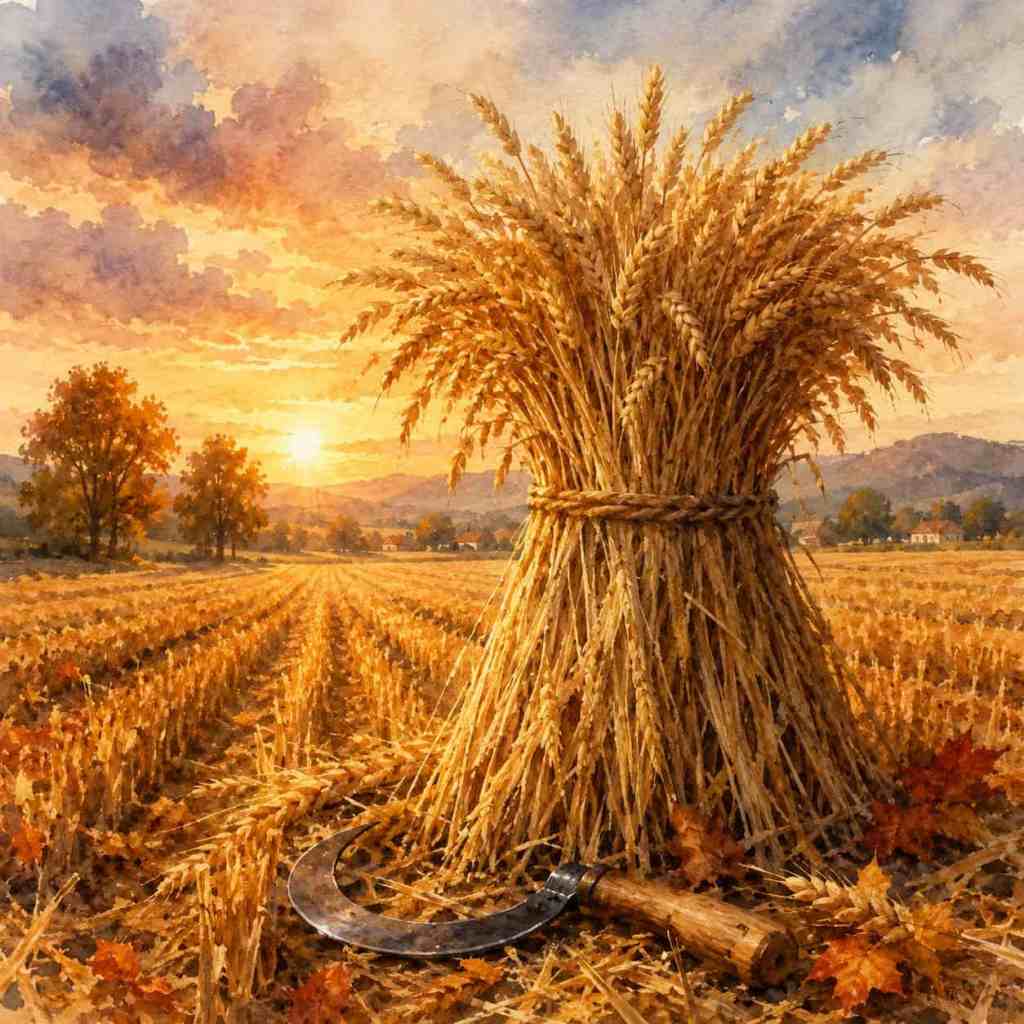
The year 2026 offers an almost textbook example of why the equinox and harvest cannot simply be glued together into one festival. Grain harvesting began in South Moravia as early as the penultimate week of June; the Strážnice Open-Air Museum held its dožínky harvest-end celebration on 26 July, with a procession, demonstrations of harvest work and grain threshing; and by 16 August, according to the Czech Ministry of Agriculture, 99.55 percent of the monitored cereal area had already been harvested. Astronomical autumn, meanwhile, was not due until 23 September.
If we wanted to make the harvest obey the equinox, we would have to persuade the combine harvester to sit beside the field for several weeks. “Not yet, Franta. It is still astronomically summer.” The grain would probably appreciate different management. Dožínky were not celebrations of a particular position of Earth in relation to the Sun; above all, they were connected with the completion of the grain harvest. Once the work was finished, the procession, wreath, music, food and celebration could begin. The calendar was free to protest. The field had the final word.
Dožínky are not Mabon in folk costume
Here comes the first major autumn internet trap. Put grain, a wreath, apples, a feast, thanks for the harvest and a few nicely colored leaves next to one another, add a sunset photograph, and the internet is ready to manufacture an “ancient European autumn-equinox ritual.” History has the inconvenient habit of asking for sources.
Dožínky belong to the agricultural year. One of their striking elements was the harvest wreath woven from grain ears and ceremonially presented to the farmer after the harvest was complete. The form of dožínky itself changed over time together with agriculture, working conditions and society. This is not a dramatic “AHA! THE TRADITION WAS A FRAUD!” revelation. Traditions change, and the ability to change is one of the reasons they survive at all.
When the harvest became an ornament
For BeadCulture, the harvest wreath is much more interesting than a decorative prop in a photograph. The National Museum in Prague describes wreaths woven from ears of grain and field flowers and ceremonially presented to the farmer after the harvest. Protective power was attributed to the circle and the plants; the wreath could remain in the household until the following year, and grain from it was sown again with the wish for a rich harvest. One object could therefore connect material from the field, celebration, protection, memory of the previous harvest and hope for the next.
In the narrow sense, of course, this is not jewelry, and certainly not “autumn-equinox jewelry.” But it is exactly the kind of material culture that shows how an ordinary material can become a culturally charged object. Adornment does not begin only with a gold chain: people decorate the body, clothing, the home, processions and ritual objects, and meaning often lies precisely in what something is made from and what happens to it afterward. In the separate atlas Harvest Jewelry and Adornments (coming soon), we therefore keep jewelry, dress accessories, wreaths, ritual objects and contemporary autumn aesthetics separate — so they do not all melt back into one very photogenic but historically suspicious basket.
Traditions are a little like family recipes. Every generation swears that it makes the cake “exactly like Grandma did” until someone finds Grandma’s notebook and discovers that she used a different fat, half the sugar, and that the ingredient the family now insists was essential entered the recipe sometime around 1987. And yet it is still a family recipe.
In the same way, we do not need to manufacture a false family tree for dožínky stretching back to one universal European harvest festival. Their real history is richer than the idea that all our ancestors celebrated the same thing and merely wore different folkloric outfits.
Žatec: when autumn arrived by train
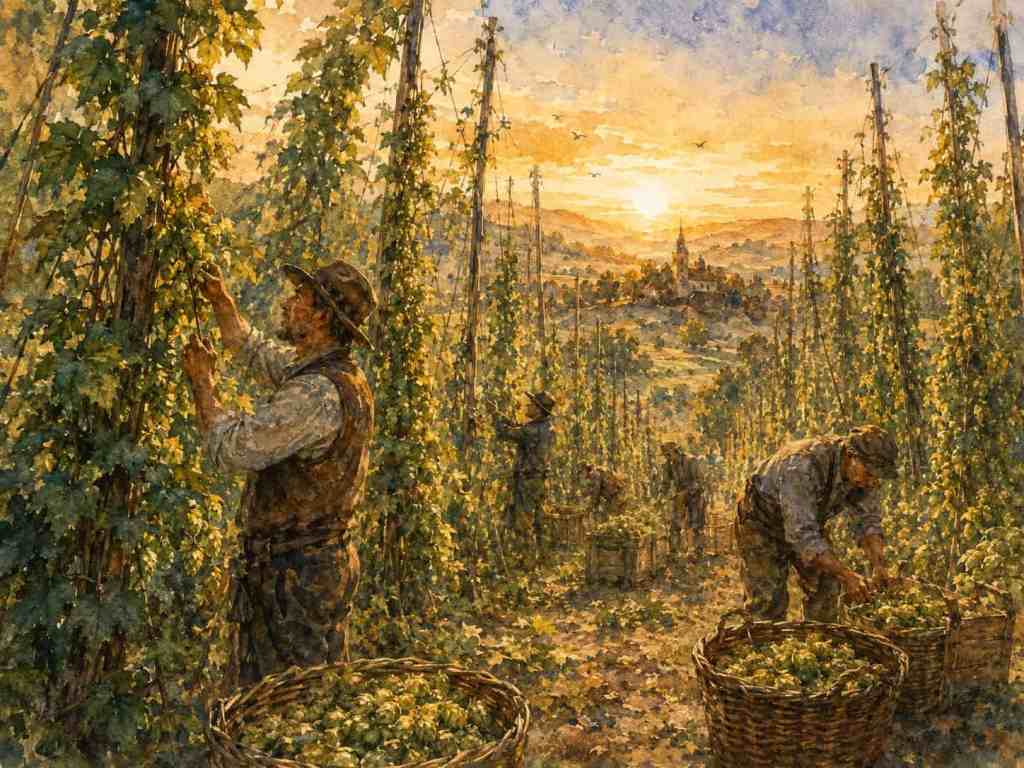
Around Žatec, the end of summer had an entirely different soundtrack. Instead of grain fields, we enter a landscape of hops, now inscribed on the UNESCO World Heritage List as Žatec and the Landscape of Saaz Hops. For centuries, hops shaped not only agriculture here but also the appearance of villages and the town, drying houses, warehouses, transport, trade and everyday life. During harvest, they could turn the rhythm of the entire region upside down for several weeks.
A century ago, thousands of seasonal hop pickers arrived in the Žatec region at the end of August. Sometimes whole families or groups from one village made the journey, and the railway had to provide special carriages because ordinary services could not absorb the influx of workers. Hold that image for a moment: late August, railway platforms, luggage, people arriving for several weeks of labor, farms and hop gardens full of seasonal workers. Long hours of picking, handing over the harvested hops, hop tokens used to record work.
For a few weeks, autumn did not arrive as a date. It arrived by train.
And the romance of hop gardens naturally had a less Instagram-friendly side: getting up early and working hard. That is a very common detail of traditional rural life that mysteriously disappears from mood boards somewhere between the linen apron, wicker basket and sunset. “Slow living” takes on a slightly different meaning when there is another row of hops waiting for you.
When hops became a wreath and a crown
The Žatec harvest also had its own language of adornment. Municipal historical sources record that during a visit by the imperial couple in 1833, local girls performed a dance with a hop wreath — the Hopfenkranzfest. It was repeated in 1835, and in 1910 photographer Josef Wara documented the tradition during a visit by Archduke Karl. Hops, then, were not merely a raw material waiting for a sack, warehouse and brewery. They could also become a festive material worn by the town as a sign of its own identity.
And the story has a surprisingly contemporary continuation. In the revived hop procession at the 2025 Dočesná festival, a fifty-kilogram hop crown led the procession and had to be carried by four men. From plant on the trellis, to wreath, to crown, we have a beautiful example of how an agricultural material can become a symbol of place. Hops apparently decided that if they had fed the town for centuries, they were entitled to dress it a little as well.
Wine: “Start without me, I’ll arrive later.”
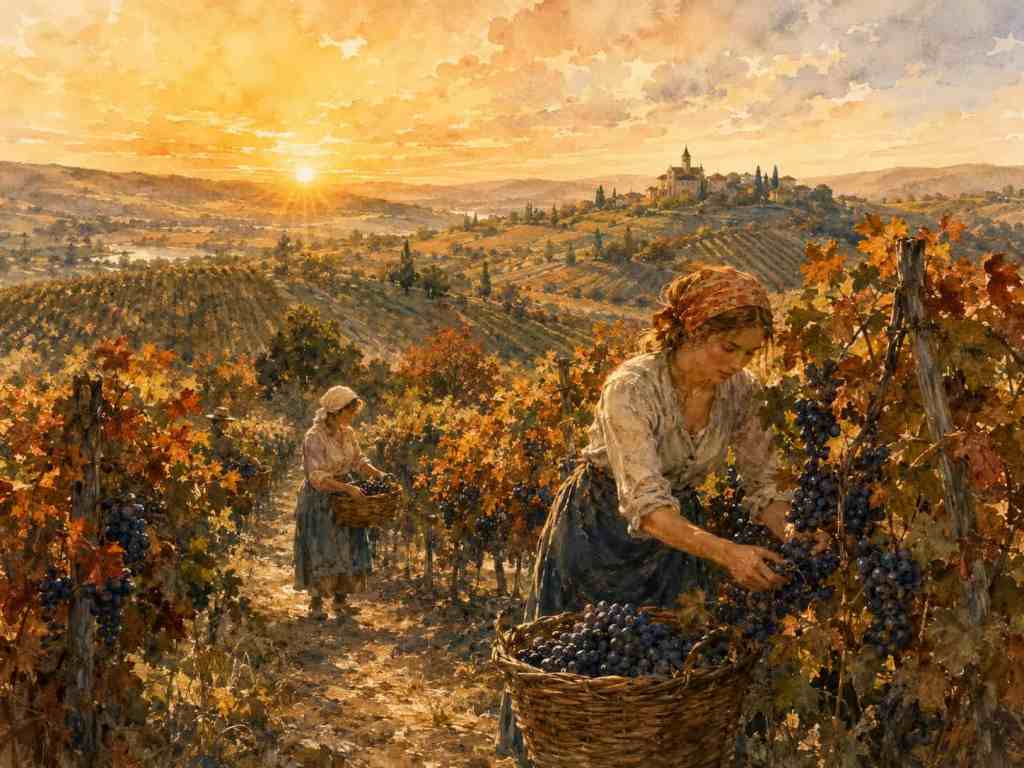
If grain and hops left any hope of an orderly autumn, grapevines cheerfully finish it off. Grain may be harvested long before the equinox and the main hop harvest takes place at the end of summer, but the wine season goes on much longer. The Pálava Wine Harvest festival in Mikulov traditionally takes place on the second weekend of September, but the grape harvest itself is not a magical DONE button. Picking grapes, pressing them and working in the winery continue according to variety, region, weather and the type of wine the winemaker wants to make.
The year 2026 offers a wonderful contrast. Dožínky took place in Strážnice on 26 July, astronomical autumn begins on 23 September, and the Vrbovec Wine Harvest with the Hroznová koza is scheduled for 31 October. In previous years, organizers associated this celebration with the end of the harvest and the pressing of the last grapes. Autumn harvest within a single country can therefore stretch its arms from July to the end of October, while the equinox stands in the middle like a person who arrived at a party exactly at seven and discovered that half the guests had already left while the other half were still looking for parking.
At this point, we no longer need a complicated diagram. Wheat, hops and grapevines simply refuse to join the same Google Calendar.
Hroznová koza: when winemaking says, “Let’s make a mascot, but somewhat ceremonially”
In the Znojmo region, the wine season has another character whose name sounds as though someone invented it after a third glass of young wine, yet it is entirely real: the Hroznová koza, literally the “Grape Goat.” Since 2021, the South Moravian Region has listed it among its intangible elements of traditional folk culture as a wine-related tradition of the Znojmo border region. It is a richly decorated figure of a male or female goat that received ceremonial respect during the grape harvest. So the wine season managed not only grapes, barrels and aching backs, but also a festively decorated goat. That is already a stronger feat of organization than most corporate team-building days.
Similar customs were known in Lower Austria. The tradition weakened over time after the dissolution of Austria-Hungary and after the Second World War, and was revived in the Znojmo region in more recent times. This is also a useful reminder that traditions are not porcelain figurines kept under glass. Sometimes they disappear, sometimes they return, and sometimes after decades they reappear among people who decide: “You know what? The goat was actually a pretty good idea.”
For our story, the most interesting part is what we can actually see and document: grapes, wine landscape and festivity are translated into a decorated object. This is where BeadCulture perks up. Material, adornment, symbol, procession — all neatly together. The deeper origin of the custom is interpreted in different ways, however, so we are not going to stage a historical talent show called “Roman, Celt or harvest deity?” and pick the winner according to the nicest costume. We stay with what can be documented and leave the fog where the fog genuinely is.
The costumed procession at the Pálava Wine Harvest needs to be read just as carefully. It is visually important, festive and central to the present form of the event. But specific beads, garnets, ribbons or other accessories belong to particular regional and festive forms of dress. They do not automatically become “wine-harvest jewelry,” let alone “equinox jewelry.” Otherwise we could manufacture a new folklore tradition in two sentences, and the internet already has that department well staffed.
And then there is Mabon
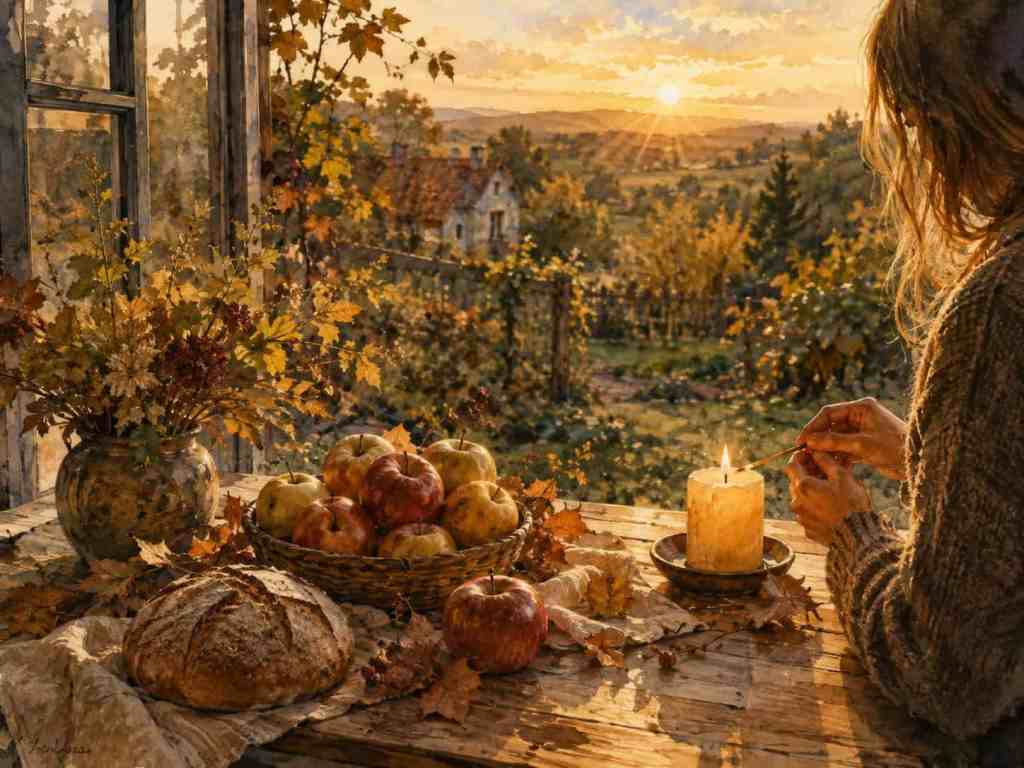
Into all this agricultural anarchy enters yet another autumn clock: contemporary Pagan and Wiccan celebrations of the equinox. In Czech Wiccan circles as well, the name Mabon is used for the autumn equinox, and for people who celebrate the Wheel of the Year, the astronomical equinox itself can be an important point in the season.
Here we need to hold two things at once: Mabon is not an ancient Czech holiday, but that does not mean contemporary Mabon is not a real tradition. Both can be true at the same time. History occasionally manages more than one checkbox.
The use of the name Mabon for the modern Pagan celebration of the autumn equinox is relatively recent. American Pagan writer Aidan Kelly has described choosing the name in the 1970s, drawing it from Mabon ap Modron, a figure in Welsh literary and mythological tradition. The small but crucial distinction is this: Mabon ap Modron is not a modern invention; what is modern is using his name for the autumn-equinox festival.
The internet sometimes considers that distinction too small to be allowed to spoil a good story. The usual process follows: add a few centuries to a modern tradition, perhaps a few millennia, a Celtic knot, a candle, the mysterious phrase “our ancestors believed,” and voilà — the historical family tree is complete.
BeadCulture is confiscating the stamp this time.
A modern tradition does not need to pretend it is ancient in order to have meaning. People have always created new rituals. The birth of a tradition is not a cultural crime. Falsifying its birth certificate is another discipline.
When today’s Mabon meets Czech autumn
The fact that dožínky and Mabon do not share one historical origin does not mean they are forbidden from meeting today. A person living in Czechia can celebrate Mabon and use apples from their garden, live in South Moravia in the middle of wine season, know harvest customs from their family or region, and at the same time practice a modern Pagan tradition. They may consciously combine some of these things and give them new personal meaning.
Culture is not a police registry where someone arrives and announces, “Sorry, this apple is folkloric and may not enter a Wiccan ritual.” People connect inspirations, traditions meet, change, are translated into new environments and acquire new layers. We only need to avoid confusing “people connect these things today” with “they have always been one tradition.” There is a fairly large historical chasm between the two, and five Pinterest posts will not build a bridge across it. Not even with a very nice font.
What about jewelry for Mabon?
Contemporary Pagan practice can of course include jewelry. Some practitioners today wear their own Pagan jewelry or objects of personal significance during ritual. That is a living modern tradition, and it is not somehow “less real” because it is not two thousand years old. What we do not have is a safe historical bridge to the claim that there was one unified ancient Celtic or ancient Czech “Mabon jewelry” tradition with a mandatory list of stones, symbols and colors.
With jewelry, we therefore keep three layers apart. Historical reconstruction asks what is actually documented. Contemporary ritual practice looks at what people truly use today. And design inspiration is free to take an ear of grain, hop cone, grape cluster, apple, vine leaf or the circle of a wreath and turn it into new autumn jewelry. That last option is completely legitimate — we simply do not attach a false Iron Age birth certificate to it. The separate article Mabon Is Not an Ancient Celtic Festival explores this distinction in more detail. (coming soon)
Inspiration, not an archaeological find. Grain ears, grapes, hops, apples or vine leaves can be excellent motifs for contemporary autumn jewelry. The fact that they look beautiful beside a candle and cinnamon does not turn them into historical evidence. Pinterest remains outside the witness box this time.
When the harvest is worn: beads, garnet and cloves
If you are now waiting for a list of “traditional Czech autumn-equinox jewelry,” we have bad news for Pinterest and good news for history: no such unified category is documented. What we do have is real Czech folk jewelry and real materials worn with festive and regional dress. That is ultimately much more interesting than retroactively painting every garnet as a “mystical stone of autumn.”
The collections of the National Museum in Prague include, for example, a multi-strand necklace of light pink glass beads from the second half of the nineteenth century and a garnet necklace with silver ornaments from the first half of the nineteenth century, both catalogued in the ethnographic collection among folk textiles and accessories. The Ethnographic Museum also points to an even more fragrant material: a girl could wear beads made from cloves and glass pearls with folk dress to a dance, and cloves were also used to adorn brides. Glass, garnet, silver, textile and spice therefore belong to the real world of Czech adornment — just not to one invented “equinox jewelry box.”
We will be equally careful with Czech garnet. Its history is highly important to Czech jewelry, but that does not mean it was an “autumn stone” or part of a harvest ritual. To a modern eye, its red color may evoke rose hips, wine and autumn leaves; that is a beautiful contemporary aesthetic association, not evidence of historical seasonal symbolism. The distinction is small, but it saves a great many articles from accidentally inventing a new folklore tradition within three paragraphs.
When the harvest moved into the jewelry box
To see that grain and grapevines are perfectly legitimate jewelry motifs even without an invented equinox genealogy, we only need to look beyond Czech borders. The British Museum holds an English diamond aigrette in the form of a ribbon-tied sheaf of wheat ears from around 1825; individual ears could also be mounted in a tiara. The Metropolitan Museum of Art holds a necklace by Louis Comfort Tiffany from around 1904 in which tiny black opals form grape clusters and green enamel on gold forms vine leaves. Harvest really does enter jewelry — but each time in a particular period, style and cultural setting.
So what are we actually celebrating?
Perhaps we do not need to find one Czech “autumn-equinox festival” at all. It is more interesting to accept that people recognized seasonal turning points in different ways and that those rhythms did not have to meet on one single day. Today we add meteorological seasons, a precisely calculated equinox and new ritual traditions that give the astronomical moment their own meaning.
All of this fits inside Czech autumn, just not inside one historical sack. The question “How did our ancestors celebrate the equinox?” may therefore be aimed slightly off target: specific work, local festivities and variable seasons are easier to document than one universal autumn rite. Real life was less tidy than a calendar — which is exactly what makes it more interesting.
The autumn that arrived several times
The equinox can be calculated to the minute. The autumn people actually live is not so obedient. In one place it may arrive with the final sheaf of grain in the middle of summer; around Žatec it once came at the end of August together with trains full of seasonal hop pickers; and in South Moravia it may smell of young wine while vineyard work continues deep into October. For someone who celebrates Mabon today, the equinox itself may carry the greatest weight.
And then, of course, there is the oldest European meteorological method of all: you step outside in the morning wearing something completely unsuitable and the weather informs you within seconds that the season has changed. No calculations, no UNESCO and no consultation with the Celts.
Czech autumn, then, is not one long-lost festival waiting to be found under layers of history. It is several rhythms of one landscape, overlapping, missing one another and occasionally getting in each other’s way — or into each other’s hops. Grain is finished while the vines are still working, astronomy arrives exactly on time but no one stops a combine harvester for it, old agricultural customs live beside new rituals, and people today create further stories from different layers of autumn.
We do not need to force them into one system. Only when we stop squeezing them into a single “ancient autumn festival” do they become truly interesting. And if wheat, hops, grapevines, astronomers and Mabon ever agree on one shared date, we will of course report it.
Until then, everyone is running on their own schedule.

When is the autumn equinox in Czechia in 2026?
The autumn equinox occurs on 23 September 2026 at 2:05 a.m. CEST. It is a precise astronomical instant. It does not mean that all autumn work, festivals or cultural traditions begin on that date.
Are dožínky a Czech celebration of the autumn equinox?
No. Dožínky are primarily connected with the completion of the grain harvest, so their date depends on the harvest itself. In 2026, for example, dožínky at the Strážnice Open-Air Museum took place on 26 July, almost two months before the astronomical equinox.
Is Mabon an ancient Czech or Celtic festival?
Mabon is a name used today for the autumn equinox in some modern Pagan and Wiccan traditions, including in Czechia. The use of the name Mabon for this festival is modern, however, and cannot simply be presented as a documented ancient Czech or Celtic name for an equinox celebration.
Why does the grape harvest not always take place around the equinox?
Because grape harvesting follows ripeness, grape variety, local conditions, weather and the winemaker’s goal. The wine season can therefore continue long after the September equinox. In Vrbovec, for example, the Vrbovec Wine Harvest with the Hroznová koza is scheduled for 31 October 2026; in previous years, organizers associated the event with the end of the harvest and pressing the final grapes.
Is there one single “Czech beginning of autumn”?
It depends on what we mean. Astronomical autumn begins with the equinox, meteorological autumn on 1 September, agricultural work follows its own seasonal rhythm, and cultural or religious traditions may use other reference points. That is why Czech autumn is more interesting as a tangle of several different clocks than as one single festival.
🧵 Where the threads lead
Timeanddate — Seasons, Equinoxes & Solstices for Prague
For the exact local time of the 2026 autumn equinox in Prague and basic astronomical context.
Czech Ministry of Agriculture — 7th harvest report, 17 August 2026
For the start of the 2026 grain harvest in South Moravia and the figure showing that 99.55% of the monitored cereal area had been harvested by 16 August 2026.
Strážnice Open-Air Museum / National Institute of Folk Culture — Dožínky 2026
For the concrete example of dožínky on 26 July 2026 and their connection with harvest work, procession and harvest celebration.
National Museum — Harvest wreaths
For the connection between dožínky and the end of the harvest, wreaths made from grain ears and field flowers, their protective meaning, keeping them until the following year and sowing grain from them again.
UNESCO World Heritage Centre — Žatec and the Landscape of Saaz Hops
For the historical depth of hop growing around Žatec and the way cultivation, processing and trade shaped the landscape, settlements and infrastructure over centuries.
City of Žatec — Žatec and the Landscape of Saaz Hops
For historical information on seasonal hop pickers, their accommodation, transport and special railway carriages during the harvest.
City of Žatec — From the history of the traditional Žatec Dočesná
For the Hopfenkranzfest, or dance with a hop wreath, during the imperial visit of 1833, its repetition in 1835 and photographic documentation in 1910.
City of Žatec — 68th Dočesná: promenade, hop crown, rain and a dancing square
For the revived hop procession and the fifty-kilogram hop crown carried by four men in 2025.
Pálava Wine Harvest — official website
For the date of the Pálava Wine Harvest festival in 2026.
City of Mikulov — Pálava Wine Harvest
For the second weekend in September, continuing winery work later into autumn, and the costumed procession as part of the contemporary festival.
Vrbovec Winemakers’ Guild — Vrbovec Wine Harvest 2026
For the date of the Vrbovec Wine Harvest with the Hroznová koza on 31 October 2026 and context from previous years connecting the celebration with the end of harvest and pressing the final grapes.
South Moravian Region — List of intangible elements of traditional folk culture
For the listing of the Hroznová koza as an intangible cultural element of the South Moravian Region and the documented framework of this Znojmo wine tradition.
National Museum — Fragrant clove jewelry
For necklaces made from cloves and glass beads worn with folk dress to a dance, and the use of cloves in bridal adornment.
eSbírky / National Museum — Glass beads
For the multi-strand light pink glass beads from the second half of the nineteenth century in the ethnographic collection.
eSbírky / National Museum — Garnet necklace
For the garnet necklace with silver ornaments from the first half of the nineteenth century and its classification in the ethnographic collection.
Wicca.cz — Wheel of the Year overview
As evidence of the contemporary use of the name Mabon for the autumn equinox in Czech Wiccan practice.
Ronald Hutton — Modern Pagan Festivals: A Study in the Nature of Tradition
For scholarly context on the formation and construction of the modern Pagan festival calendar.
Aidan Kelly — About Naming Ostara, Litha, and Mabon
For Kelly’s own account of choosing the name Mabon for the autumn equinox in 1974.
John Beckett — Mabon: A Solitary Ritual
As a concrete example of contemporary Pagan practice in which personal Pagan jewelry may form part of ritual; not as evidence for historical “Mabon jewelry.”
British Museum — Wheat-ear aigrette
For the English diamond aigrette in the form of a sheaf of wheat ears from around 1825 and the possibility of using the individual ears in a tiara or wreath.
The Metropolitan Museum of Art — Louis Comfort Tiffany, Necklace
For the necklace from around 1904 in which black opals form grape clusters and green enamel on gold forms vine leaves.
📚 Want to go deeper?
Ronald Hutton — The Stations of the Sun: A History of the Ritual Year in Britain
A major study of historical seasonal festivals, their transformations, and what can and cannot safely be presented as ancient tradition.
Ronald Hutton — The Triumph of the Moon: A History of Modern Pagan Witchcraft
For a deeper history of modern Paganism and Wicca and their relationship with older European cultural layers.
National Institute of Folk Culture
For further exploration of the Czech agricultural year, harvests, dožínky, material culture and regional traditions.
National Museum — Harvest wreaths
For the concrete material and symbolic layer of the harvest wreath and its place in Czech harvest traditions.
And if Czech autumn has just pulled you into a small seasonal rabbit hole, we are continuing. Harvest wreaths, wine harvests, hop-picking brigades, posvícení (local feast-day celebrations), Mabon and individual regional autumns all deserve stories of their own. One autumn article could never keep them all under control anyway — as we have just discovered, they cannot even agree on when autumn begins.