
The 1920s had barely closed the door on the war when a saxophone sounded from the other side. Cities glowed, cars honked, cinemas manufactured new gods, and advertising promised that the future could be bought in a department store — preferably today, and on installments.
After years of trenches, epidemics and funerals, the younger generation had a somewhat reduced appetite for lectures about what was proper. And some young women began to look as if they had accidentally left the rules in the hallway before going out: hair cut short, lips red, skirts higher, cigarette in hand, and the evening continuing into places where respectable girls were supposedly never meant to end up.
The flapper. To one part of society, an exciting image of the modern woman. To another, proof that civilization would probably end by Thursday at the latest.
And pearls around her neck. Sometimes real, sometimes imitation, sometimes expensive and sometimes utterly ordinary — but they swung so effectively while dancing that a century later we turned them into an almost mandatory uniform for the entire decade. Add feathers, fringe and a Gatsby Party sign, and the internet feels it has just reconstructed 1925 with scholarly precision.
Lola: „Ban alcohol and expect people to stop drinking. That’s adorable.“
Grandma: „When society starts being afraid of a haircut, the problem is usually somewhere other than the hair.“
But it is precisely behind those doors that the story gets really good. The flapper was not just a fashionable figurine draped in pearls. She stood right at the point of collision: postwar hunger for life against old morality, the new city against ideas of respectability, Prohibition against illegal bars, African American jazz against white mass culture, and diamonds against cheap costume jewelry. The 1920s glittered — and at the same time were full of inequality, bans and double standards.
And occasionally there was gin, cigarettes, morphine, cocaine, a gangster, a cop, and somebody absolutely convinced that short skirts were to blame for everything.
Welcome to the decade that loosened its collar
1918 silenced the guns, not the nervous system. After the First World War came a mixture of relief, trauma, economic growth, urbanization, new technologies and consumer culture; cities accelerated, and people learned to live in a world where a film star could change half the country’s hairstyle in a week.
Ready-to-wear clothing was almost as important to this story as Hollywood. Style no longer had to travel only from luxury salons to women who could afford couture; it moved through department stores, magazines, advertising, paper dolls and film. Clara Bow and other stars showed that a modern look could be copied even when the diamond budget remained safely in the realm of fantasy.
Then came 1920. The United States ratified the 19th Amendment and prohibited denying the vote on the basis of sex. A huge turning point — but definitely not a magic button marked “all women are free now.” Racist laws, tests, poll taxes, intimidation and other barriers still prevented many African American women and others from voting.
That matters precisely because the flapper later became such a convenient symbol of freedom. History was not a poster. One woman could bob her hair, go to the cinema and vote; another could work just as hard, wear a completely different hairstyle, and still be kept out of the polling place by the system.

The state said no to alcohol. America replied: fine, but quietly
Prohibition is one of those historical situations that sounds almost like a screenplay until you realize it really happened. The 18th Amendment and the Volstead Act sharply restricted the manufacture, sale and transport of alcoholic beverages from 1920 — and in doing so created a vast black market, new business opportunities for gangsters and a highly creative public relationship with the phrase “obeying the law.”
Speakeasies multiplied behind discreet doors, in back rooms, basements and clubs. Older saloons had largely been male spaces, while in many speakeasies women and men met, drank and danced together. Some women ran venues themselves, others smuggled alcohol, and still others simply took advantage of the fact that the night city suddenly offered a space slightly less obedient than the one available to the previous generation.
Period photographs are wonderfully eloquent on this point. In 1926, for example, dancer Mlle. Rhea was photographed in Washington with a fashion accessory Lola would instantly have called “a practical pocket for moral panic”: a flask strapped to her garter.
But the speakeasy was not a feminist Disneyland. It was illegal, often tied to organized crime, sometimes violent, and certainly not equally accessible to everyone. That may be the most interesting thing about the 1920s: almost every object that looks like a symbol of freedom has a label sewn onto the back listing its price, class, race or risk.

Jazz was not wallpaper. It had parents, cities and a very specific history
Jazz drifted through the air like a cat along a windowsill — velvety, self-assured and with a tail full of rhythm. But this sound did not arise as decoration for fringe and pearls. Jazz grew out of African American musical traditions of the American South and became one of the defining sounds of American modernity in the 1920s.
Without Black musicians, the Jazz Age would not have had its characteristic pulse. Yet the same society could adore the music while segregating its creators, hiring them in famous clubs while denying them equal access to doors, tables, hotels or political power.
The Charleston became one of the symbols of the decade, and this is exactly where fashion meets movement. Looser dresses, shorter hemlines and lighter construction allowed the body to work differently from earlier silhouettes. And when dance changed, what jewelry did on the body changed too.
We do not toss the Lindy Hop into the same bag just because it sounds good next to the word “jazz.” It belongs above all to Harlem dance culture of the late 1920s, and its history deserves precision of its own, not a historical cocktail of “everything that is fun to dance.”
And yes, there were drugs under the glitter too
There is no need to sterilize the 1920s until nothing remains but Art Deco wallpaper. The modern city had a darker medicine cabinet as well: morphine, opium, heroin and cocaine already had histories of medical and non-medical use, and society was going through a rapid shift from relatively looser availability toward regulation, criminalization and a new moral panic.
The Harrison Act of 1914 introduced federal registration and control of trade in opiates and coca products. Enforcement tightened during the 1920s, a separate narcotics administrative structure emerged, and addiction was increasingly moved from a medical frame into a criminal one. Racial and class prejudice helped shape who the public imagined as a “dangerous user” and who was treated as a patient.
But this is not a license for the sentence “flappers were all doing cocaine.” We throw that shortcut away as quickly as a carnival headband with plastic feathers. Drugs belong in the wider picture of urban modernity, medicine, the underworld, addiction and repressive policy — not as a compulsory prop for every woman with a bob.
Still, it would be false to tell the Jazz Age as a sterile party where the only danger was catching your pearls in the fringe. Alcohol, illegal trade, addiction, police, criminalization and organized crime all belonged to the same urban world that manufactured its glamour.
Lola Tralala: „Morphine, cocaine, gin, gangsters… and society is worried about skirt length. Excellent.“
Bobbed hair, lipstick and the skirt that scandalized half the relatives
The flapper look had strong visual markers precisely because they were immediately readable. Bobbed hair, more visible makeup, a straighter silhouette, a lower waist and shorter skirts signaled modernity before anyone even opened her mouth.
But please, let’s throw out the idea that every skirt ended halfway up the thigh. Hemlines changed across the decade and often reached the knee, sometimes higher; and one fashion illustration is not a national uniform. Film costume has a peculiar talent for adding two layers of fringe, removing ten centimeters of fabric and pretending it has just completed archival research.
And the corset? It did not dramatically die on the staircase of history one morning either. The construction of underwear changed, ideals of silhouette changed, and methods of shaping the body changed. The 1920s brought a different line, not a magical shutdown of underwear history.
Short hair, however, did something very concrete for jewelry: it exposed the ears, jaw and neck. Drop earrings suddenly had a stage that long hairstyles had partly concealed. Add dance, and earrings stopped merely being worn — they began to perform.

Jewelry finally got choreography of its own
A long necklace is beautiful in a display case. On a dancing body it becomes a completely different kind of object. It swings against the fabric, flips, catches the light, occasionally escapes its intended position, and during a sufficiently energetic Charleston can remind you that physics is part of fashion too.
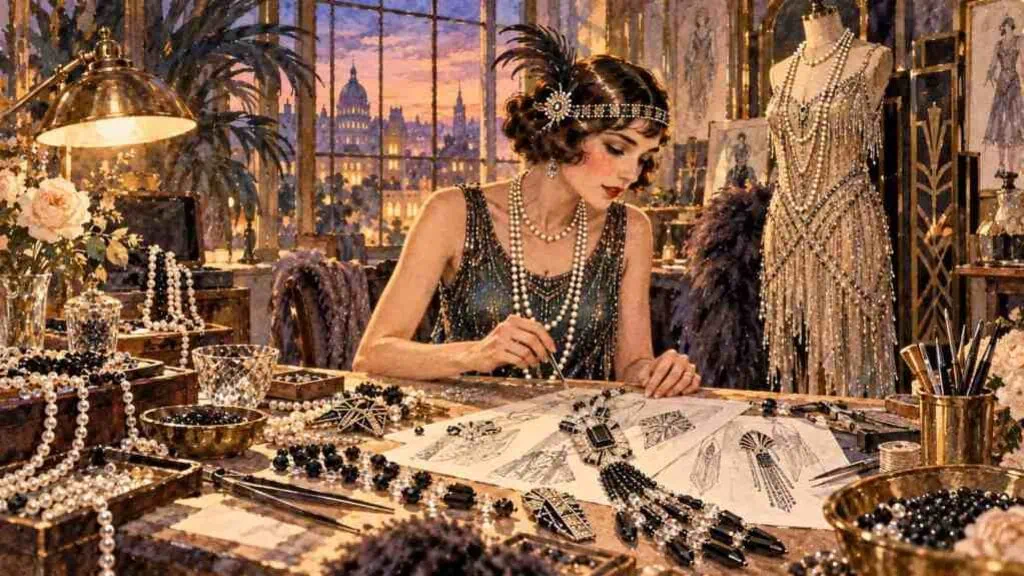
Long pearl strands and sautoirs, drop earrings, bracelets, brooches and Art Deco geometry are now strongly associated with flapper style. We just need to resist the internet’s tendency to turn every white bead into a natural pearl and every party into a high-jewelry collection.
At the top end of 1920s jewelry we find platinum, diamonds, colored gemstones, sharp geometry and technical precision. Alongside it existed a much larger world of costume jewelry, glass, imitation pearls and more affordable ornaments that allowed women without a family vault the size of a small bank to wear a modern look.
And that is far more interesting for Bead Culture than another legend about “diamond flappers.” Style does not spread only through expensive originals. It spreads through imitation, new materials, mass production, advertising and the desire to look like the world someone has seen at the cinema.

For more detail on materials and styling, see our separate article Flapper Jewelry: Meaning and Styling Tips.
A pearl is not a ballot paper
It is terribly tempting to write: “Pearls symbolized women’s emancipation.” It looks beautiful, it fits on Pinterest, and the only problem is that history does not behave that obediently.
Jewelry can express modernity, status, taste, visibility, belonging to a particular style, or simply the pleasure of adornment. For some women it may have been a conscious part of rejecting older norms; for others it was a fashion purchase, a gift, an imitation of a more expensive piece, or something that simply worked perfectly with the dress.
An ornament does not have a political program of its own. Meaning is created between the object, the body, the situation, money, the audience and the stories we later begin to tell about it.
Lola comments: „If a necklace can deliver emancipation, the suffragists worked far too hard.“
Who did not fit on the poster
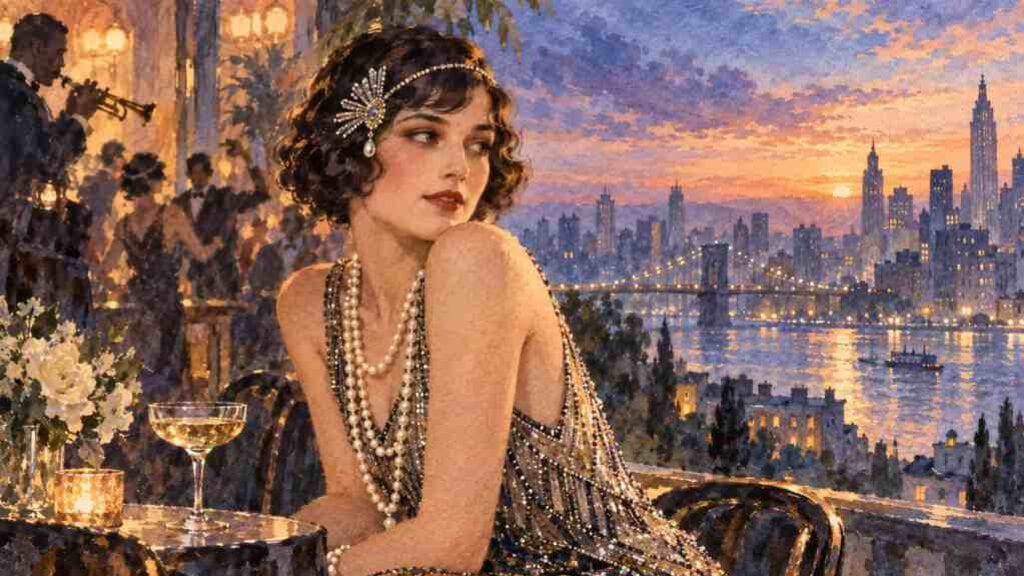
Today’s image of the flapper is often suspiciously uniform: young, slim, white, in an evening dress, with a bob, a headband, a glass in hand and an expression suggesting she has just broken three rules and is already planning the fourth. It is an effective image. And like every effective image, it hides something too.
Class determined what people could afford, where they could go and how much free time they had. Ready-to-wear made some fashions more accessible, but it did not erase economic difference. Race shaped access to venues, political power and safety in public space.
African American women were part of urban modernity and cultural change, but the dominant white media image often pushed them to the margins. The same culture could dance to the music of Black artists while maintaining segregation. That is not an extra detail; it is one of the main cracks in the glittering surface of the Jazz Age.
The flapper is therefore not “the woman of the 1920s.” She is one powerful cultural type through which we can trace arguments about modernity, women’s behavior, consumption, the body and public space. And the more we stop mistaking that type for an entire population, the more interesting she becomes.
What the flappers left behind
The flapper archetype survived its particular decade with admirable nerve. It returns whenever culture needs an image of a young woman who is too loud, too visible, too fashionable or too independent to feel comfortable.
Fashion retained its fascination with the bob, the straighter silhouette, fringe, Art Deco geometry and long jewelry. Film and television still use the Jazz Age as shorthand for luxury, scandal, prohibition and a night that refuses to end. And retro revival regularly turns the flapper into a mixture of history, fantasy and party shop.
But the real legacy is better than the costume. The flapper shows us how mass media manufacture archetypes, how fashion travels between classes, how movement changes clothing and jewelry, and how quickly social conflict can become an aesthetic that a century later is sold back to us as a themed party.
And jewelry remains exactly where it interests us most: at the boundary between the body, material, money and what we want to show others about ourselves. Sometimes diamond. Sometimes glass. Sometimes pearl. And sometimes just an object that behaves more dramatically on the dance floor than its owner.
Want to follow the word flapper itself and its historical meaning? Continue with What Does It Mean to Be a Flapper?. If you are interested in the relationship between style and emancipation, read How Flapper Style Shone in the Fight for Emancipation. To follow how a fashion type became an icon of self-expression, continue with Flappers: Pearls, Rebellion and New Female Freedom. We also have The Flapper Glossary: Words, Slang and Wordplay of the Jazz Age.
FAQ: flappers without the fringe fog
What does the word flapper mean?
In the American context of the 1920s, it referred to a young modern woman associated with new fashion, urban culture, dancing, smoking, drinking and other behaviors contemporary society saw as departures from older norms for women. It was not an organized group with membership cards and a uniform dress code.
Did flappers really wear skirts above the knee?
Sometimes, yes, but hemlines changed during the decade and many dresses reached roughly to the knee. The carnival version tends to be shorter and far more fringed than historical reality.
Were all flappers feminists?
No. The flapper look could be connected to self-expression and rejection of some older norms, but you cannot automatically read an individual woman’s political views from her haircut, dress or jewelry.
Why are pearls so strongly associated with flappers?
Long pearl necklaces and their imitations worked well with the straighter dress silhouette and were highly visible in motion. Later film and costume culture turned them into one of the strongest visual codes of the entire era.
Were those long pearls always real?
Definitely not. Alongside expensive natural and cultured pearls were imitations, glass and other more affordable materials. “Pearl look” is more accurate than imagining every woman dancing with the family fortune around her neck.
What did flappers have to do with Prohibition?
The flapper image became strongly associated with urban nightlife, speakeasies, alcohol and breaking social rules. Prohibition also opened new illegal business roles that women entered too — from club patrons to smugglers and venue operators.
Did flappers take cocaine and morphine?
It is not honest to make that a typical flapper trait. Opiates and cocaine, however, were part of the wider early-20th-century world of medicine, addiction, criminalization and the urban underworld. They belong in the article as historical context, not as a compulsory accessory to every bob haircut.
Why are flappers so closely associated with jazz?
Because jazz, dance culture and urban nightlife were central to the Jazz Age. At the same time, it is essential to say plainly that jazz has African American roots and that its creators faced segregation and racism in the same society.
Did flappers exist only in the United States?
The term is most strongly associated with the Anglo-American world, but different versions of the “modern woman” emerged in other countries too. They had their own names, local conditions and cultural meanings; it is not useful to mechanically relabel the whole world as flapper.
Is today’s Gatsby party a historical flapper reconstruction?
Usually it is more of a mix of 1920s inspiration, film glamour and modern party aesthetics. That is not a crime against humanity; it is simply useful to know that feathers, fringe and three meters of pearls do not automatically make an archival document.
🧵 Where the threads lead
Period newspapers, archival material, museums and institutions from which this story is stitched:
- Library of Congress — Flappers: Topics in Chronicling America — period press, bobbed hair, short dresses, the Charleston and the flapper phenomenon itself.
- Library of Congress — Those Fluttering Flappers! — period images of the modern woman, smoking, driving, drinking and dancing.
- Library of Congress Law Blog — Broads and Bootlegging — women, speakeasies, bootlegging, public drinking and gender change during Prohibition.
- Library of Congress — Prohibition: A Case Study of Progressive Reform — Prohibition, speakeasies, bootlegging and the problems of enforcement.
- Smithsonian National Museum of American History — Bootlegging — the illegal alcohol market, organized crime and the material culture of Prohibition.
- Smithsonian — Jazz and Blues — the African American roots of jazz.
- Smithsonian National Museum of American History — Paper dolls and ready-to-wear brought flapper fashion to the masses — Clara Bow, ready-to-wear and the mass spread of style.
- The Metropolitan Museum of Art — Scrapbook with Jewelry Designs — Art Deco geometry and jewelry design.
- The Metropolitan Museum of Art — The Alluring Body — the relationship between jewelry, the body and self-styling.
- U.S. National Archives — Amendments 11–27 — the 18th Amendment and the legal framework of Prohibition.
- U.S. National Archives — 19th Amendment — voting rights and their historical framework.
- DEA Museum — Opium Order Form — regulation of opiates and coca products and changing approaches to addiction.
- FDA — Milestones in U.S. Food and Drug Law — the Harrison Narcotic Act and early federal regulation of drugs and narcotics.