
There are creatures that were invented so children would not wander outside at night. And then there is Lešij. He probably came into being because the forest, once upon a time, was genuinely terrifying. Not “forestcore Pinterest” terrifying, but actually terrifying: you get lost, it starts getting dark, the air turns cold, and something cracks between the trees with so much confidence that it is definitely not just a depressed little twig.
He is not the kind of creature who politely knocks on your door, introduces himself as “forest manager” and offers you visitor rules in PDF format. Lešij is more like that moment when you are walking through the woods, suddenly you are no longer sure about the path, the silence feels far too loud, and a very old thought appears in your head: “Maybe I am not the main character here.”
And that is exactly where Lešij was born.

Who was Lešij, and why he was not just a bogeyman behind a stump
In Slavic folklore, Lešij — sometimes also known as Lesovik, Leshy or Leszy — was considered a forest spirit, lord of the wilderness, protector of animals and trees. But calling him simply a “forest demon” is about as accurate as calling a volcano “a slightly warm hill”. Technically, there is a tiny piece of truth in there, but somehow the whole burning apocalypse has fallen out of the definition.
He was not an ordinary “boo behind the stump” kind of monster. Nor was he a fairy-tale villain who jumps out, roars, kidnaps a princess and waits for someone to solve the problem with a sword. He was much more unsettling, because his power did not lie only in the fact that he existed somewhere in the forest. His power lay in the fact that the whole forest suddenly started acting strange.
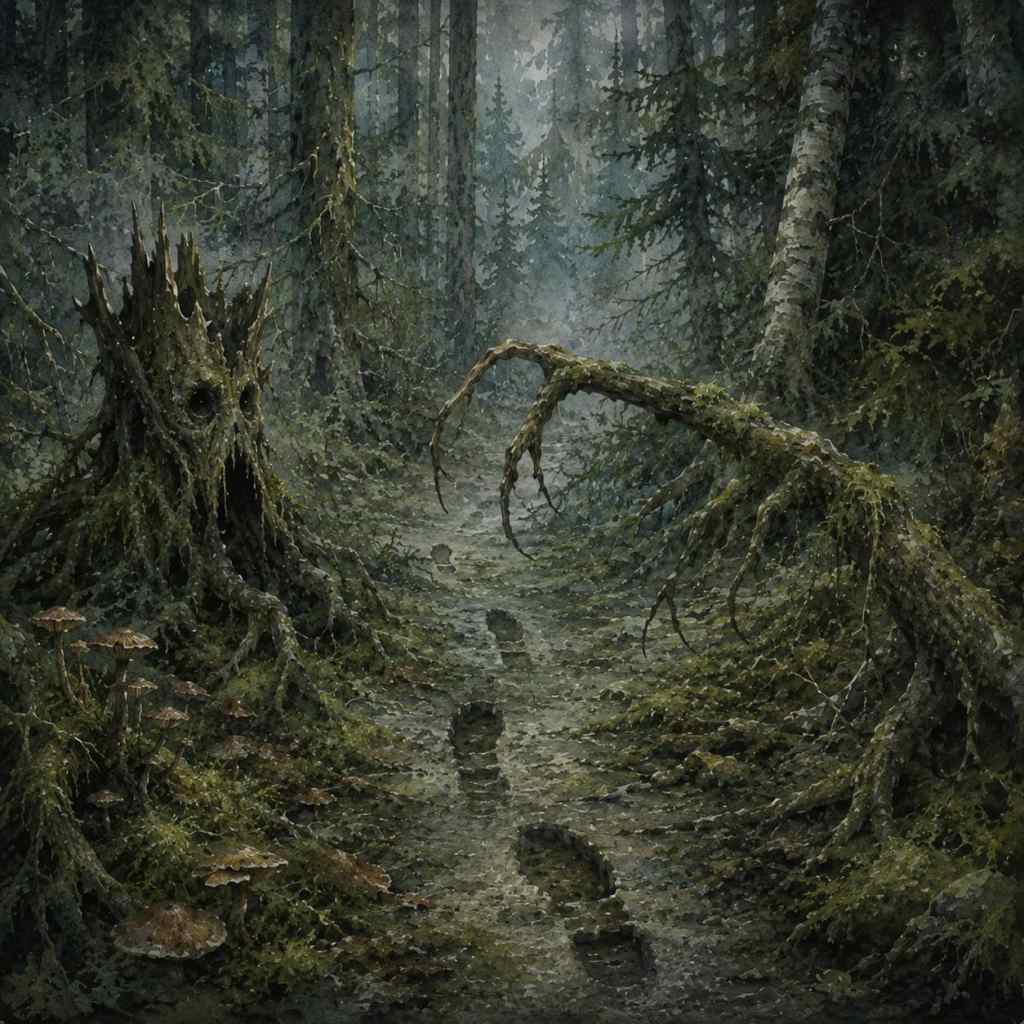
The path disappeared. Sounds behaved differently. Trees looked far too similar. Direction stopped making sense. The fog suddenly developed dramatic talent, and a person began to wonder whether they were going home, entering the underworld, or walking past the same suspiciously pleased spruce tree for the sixth time.
Lola comments:
Lešij is basically the first Slavic navigation system. Except instead of saying “turn left in 300 metres”, he says “hehehe” and sends you into a swamp.

The forest was not a wellness zone, but a foreign kingdom without signs
Today, a person puts on a technical jacket, packs a protein bar, checks a weather app and goes “to reconnect with nature”. Our ancestors went into the forest thinking: “Well, hopefully I won’t die.” And that is a very different energy.
The forest was a space outside the village, outside the fire, outside human order. The village was the world of people: fences, ovens, neighbours, chickens, work, noise and rules. The forest was the world of something else. It was huge, dark, unpredictable and full of things humans could not control. There were swamps, wolves, bears, cold, darkness, robbers and, above all, the possibility that a person might simply never return.
And the human brain hates chaos. It needs a story. When someone got lost, folklore said: “Lešij is leading you around.” When someone heard strange laughter in the treetops, folklore said: “That is Lešij.” When someone walked for three hours and ended up by the same stump, folklore sighed: “Congratulations, the forest has chosen you.”
What did Lešij look like? Well… it depended on the mood of the forest
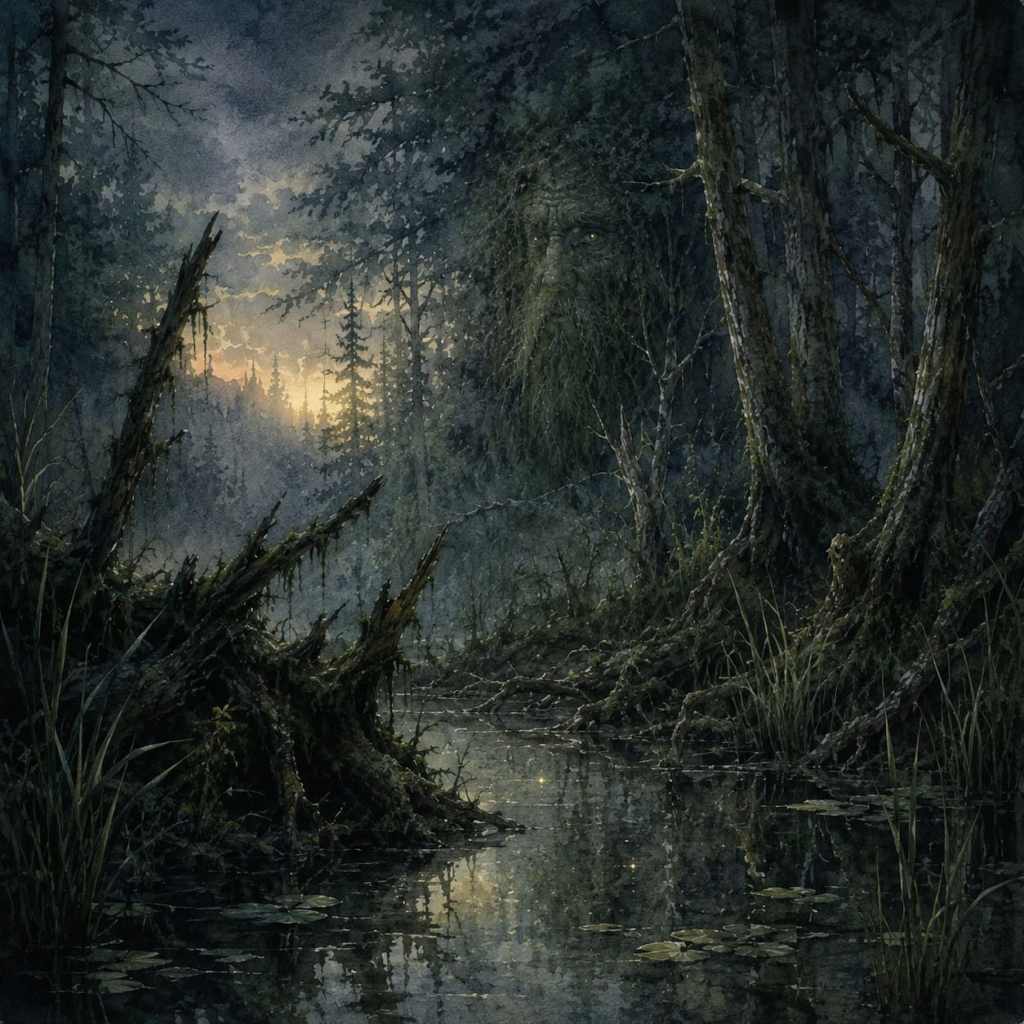
And now comes the beautiful folkloric chaos: Lešij did not have one fixed appearance. Folklore is not Marvel. It has no official character sheet, three approved costume variants and licensed merch. Lešij could be tall as a tree, small as a mushroom, covered in moss, hairy, horned, with a green beard, with eyes like forest pools — or completely invisible.
Sometimes he looked like a man. Other times like an old man, an animal, a stump, a shadow, or something a person glimpsed only from the corner of the eye and immediately regretted not having a safe job at home, such as counting sacks of flour.
In some versions, he wore his shoes backwards or his clothes inside out, which is the folkloric way of saying: “This being is not arranged correctly.” Not necessarily wrong. But different. Outside human order. Outside normal logic. A bit like opening the accounting records of someone who loved creative chaos — you know something is not right, but you do not yet know exactly how much of your soul it will cost.
Babča grumbles:
“In our day, people said that if someone got lost in the forest, Lešij was leading them around. Today people get lost in shopping centres too, so I would not blame everything on the poor mossy fellow.”
Lešij was not a character. Lešij was a problem in space
This is important: Lešij is not just a monster standing behind a tree, waiting for a dramatic entrance. Lešij is a situation. He is the moment when the entire space begins to behave strangely. The path that was clear a minute ago suddenly is not. The sound that should have been behind you comes from the left. The trees look like repeating stage scenery. And your certainty crumbles like a biscuit at the bottom of a handbag.
A classic monster can be seen. You can run from it. You can hit it with a shovel, if you are brave enough or desperate enough. But how do you run away from a forest that has taken your sense of direction?
Lešij is not a jumpscare. Lešij is atmosphere. And atmosphere is very hard to beat with a stick.
Was Lešij a guardian, a demon or a god?
The question of whether Lešij was a guardian, a demon or a god is a little tricky. The best answer is: yes — depending on who is asking, when they are asking and how afraid they are of the forest.
As a guardian of the forest, he protected a space that did not belong to humans unconditionally. He watched over trees, animals, thickets, wetlands and paths that became suspiciously philosophical at dusk. Hunters, shepherds, woodcutters and travellers had the most experience with him in stories precisely because they crossed the boundary between the human world and the wilderness.
It was believed that if a person offended the forest — by being loud, greedy, careless or far too confident — Lešij could punish them. Not necessarily kill them. Sometimes confusing someone properly is quite enough. Folklore knows very well that losing your orientation can sometimes be worse than being hit with a stick, because at least being hit with a stick is clear feedback.
As a demon, Lešij appeared more strongly in later layers of tradition, when older pagan and nature spirits were interpreted through a Christian lens. What did not come from the church was suspicious. What lived in the forest was even more suspicious. And something that laughed in the treetops, confused people and had branches in its hair was practically begging for the label “unclean force”.
But this demonisation does not mean that Lešij was originally simply evil. Rather, it shows how society’s view of old landscape spirits changed. Beings that were once part of the world gradually became suspicious, dark and dangerous. The old forest lord turned into a demon because the new world no longer had a polite category for him.
And as a god? Here we need to be careful. Lešij was probably not a god in the same sense as Perun or Veles. He was not necessarily a major deity of the Slavic pantheon. But he may have carried a very old idea of natural power, a local spirit, the lord of a particular place. In traditional thinking, the boundary between god, spirit, demon and living landscape was not always as clean as we might like to arrange it in a spreadsheet today.
Folklore is not Excel. Sadly for accountants. Fortunately for poetry.
Madam Chaotika whispers from the moss:
“Lešij is not a category. Lešij is a system error that nature refused to fix.”
Lešij and the logic of the forest
What makes Lešij fascinating is his ambiguity. He is not good or evil in a simple fairy-tale sense. He is ambivalent. He can help, harm, warn or punish. He does not behave according to a human ethical code, because he is not human. He follows the logic of the forest.
And the logic of the forest is not the logic of the visitor.
A person thinks: “I am just going to get some wood.” The forest thinks: “Ah, another creature who believes we are a self-service store.” A person thinks: “I’ll take a shortcut.” The forest thinks: “Excellent. Today we have a practical lesson in humility.”
That is why Lešij is such a powerful archetype. He embodies wilderness that is not subordinate to humans. He recalls a time when nature was not scenery, but partner, rival, provider and threat. People had to respect the forest because they depended on it, but they also feared it because they could never fully control it.
Lešij stands exactly in that tension: between need and fear, between respect and panic, between a mushroom basket and an existential crisis.

As lord of the animals
His connection with animals is another important layer. In many traditions, Lešij was the lord of forest animals. He could protect wolves, bears, deer and birds. A hunter who behaved carelessly could meet his anger. This makes Lešij not only a frightening spirit, but also a kind of ecological supervisor of the ancient world.
Today we would say “sustainability”. Lešij would say: “Touch that cub one more time and you will spend three days looking for your own shoes.”
This is what makes old folklore beautiful. It did not have modern ecological terms, graphs and conference panels where someone shows a forest in a presentation while looking very serious. But it had a story that said: the forest is not a warehouse. The forest has its lord. And if you take more than belongs to you, someone will notice.
Sibi Sibi says nothing. Then places a little leaf on the stump:
“The forest is not a warehouse. The forest is a being. Thank you for not shouting.”

Lešij, fear and the human psyche
And now the psychological part, because this is where Lešij becomes uncomfortably modern. In the forest, a person is not afraid only of a specific danger. They are afraid of losing control. In the forest, you cannot see far. Sounds break and scatter. Branches resemble movement. Shadows look like figures. The brain, that little alarmist in a bone box, begins connecting random signals into a story.
That is not weakness. It is an old survival mechanism.
When our ancestors heard a branch crack, it was safer to assume something was there than to say: “Oh please, it is just the wind,” and then become a snack for something with paws and a bad mood.
Lešij is also a cultural name for the feeling that nature has become too alive. For the moment when a person stops being an observer and starts feeling observed. And that is exactly why he still works today. We may have maps, flashlights, apps and waterproof boots, but when we are alone in the forest at dusk, a very old part of the brain still knows that silence does not have to be empty.

Lešij as a being of the border
Lešij is also a being of the border. And borders are always dangerous in folklore. The forest begins where the village ends. Where certainty, the fence, the oven, the window, the neighbour’s chicken and human noise come to an end. Beyond the village boundary, the same rules no longer fully apply.
That is why so many fairy tales and legends take place in the forest. You do not go into the forest only for a walk. You go into the forest to get lost, to find yourself, to transform, to survive or to understand something you cannot simply sit out at the kitchen table.
In such a space, Lešij acts as a guardian of the threshold. Not the threshold of a house, but the threshold of the wilderness. He stands between the world of people and the world of trees. And anyone who crosses that boundary without respect may discover that the forest is not scenery, but an active participant in the story.
Ruby Decibel, dramatic voice:
“Darling, Lešij is the stage manager of the forest. If you enter without invitation, he turns off the lights, rearranges the scenery and leaves you singing an aria of panic among the bilberries.”

Lešij today: from folklore to Pinterest in moss
It is no coincidence that Lešij fits so well into modern fantasy, horror and internet aesthetics. Forestcore, woodland goth, witchcore, dark folklore, moss moodboards, horns, branches, masks, fog, ancient trees — all of this is a modern visual language for a very old feeling.
But this is where we need to be careful. If we turn Lešij into nothing more than a beautiful green Pinterest icon, we lose his power. He is not just a vibe. He is a warning.
A warning that nature is not passive decoration. That the forest is not merely a wellness backdrop for tired urban souls. That old cultures may not have had ecology in the modern sense, but they knew very well that if humans start behaving like masters of everything, the forest will eventually send the bill. And the forest does not send reminders. It simply changes the weather, the path and the mood.
In this sense, Lešij is surprisingly relevant today. From a modern perspective, we can read him as a symbol of ecological respect. Not as a green mascot, but as a hard reminder: you are not outside nature. You are part of it. And if you forget that, it will hurt.
So who was Lešij?
He was a guardian of the forest, because he protected the wilderness from human pride. He was a demon, because from a human point of view he could frighten, confuse and endanger. He may also have been an echo of an old sacred force, because he represented the forest as a living world with power of its own.
But most of all, he was a boundary.
The boundary between human and nature. Between path and wandering. Between the known and the unknown. Between what we think we control and what actually exceeds us.
And that is why he is not an ordinary forest monster. An ordinary monster scares you and disappears. Lešij changes your relationship with the forest.
And maybe that is a good thing.
Because the next time you walk among trees and suddenly hear a branch crack in a way that sounds far too intentional, you do not have to panic immediately. Maybe it is a deer. Maybe it is the wind. Maybe it is just the old forest stretching its bones.
But maybe it is also Lešij reminding you that in his house, you should not shout, break branches, drop biscuit wrappers or behave as if every living thing were only decoration for the human mood.
Lola comments at the end:
Lešij is not a bogeyman. Lešij is the forest’s terms and conditions: nobody reads them, but everyone agrees to them the moment they step among the trees. 🌲

Princess Tisul: When a Beauty Queen Wakes Up from the Precambrian
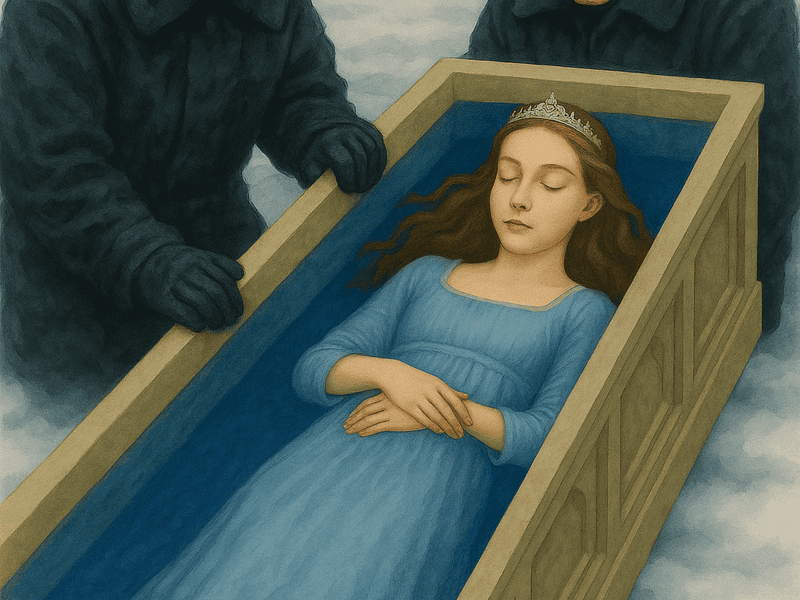
A Siberian legend tells of Princess Tisul, a beauty said to have slept for 800 million years in a marble sarcophagus filled with mysterious liquid. Myth, conspiracy, or fairytale? In Lola Tralala’s style, this story becomes a sparkling mix of mystery, absurdity, and cultural imagination.
Keep reading